Umami · Sweet · Pale
Confusingly named — processed as a green tea, but the cultivar produces unusually pale leaves rich in amino acids. Tastes broth-like and faintly sweet, like fresh edamame and spring grass. A short three-week harvest each April.
Brewing Guide
Traditional Chinese medicine treats green tea broadly as cooling — clearing summer heat, calming the liver, supporting clear-eyed focus. Anji Bai Cha is read inside that tradition as a particularly gentle expression: the cool-spring chemistry produces a cup low in the bitter catechins that make some greens harsh on an empty stomach, and high in the smoother, sweeter amino acids associated with calm rather than stimulation. It is the green most often recommended in Zhejiang for late afternoons and for drinkers who find ordinary green tea too sharp.
Modern lab work backs the framing without quite settling it. Bai Ye 1 leaf has been measured at 6–7% total amino acids by dry weight — roughly twice the level of standard green-tea cultivars — with L-theanine alone making up over half of that load. L-theanine has been studied for its association with alpha-wave brain activity and for its capacity to soften caffeine's edge into a steadier, more focused alertness. None of this is a medical claim — but it does explain why the cup reads the way it does, calm and clear without the green-tea jitter.
Tradition
Drunk through long study afternoons in Zhejiang for a quiet, clear-headed alertness — the gentlest of the green teas.
Modern lens
Unusually high L-theanine content, studied for its association with alpha-wave activity and a smoother caffeine response.
Tradition
The "broth" character of the cup is read as nourishing in TCM — a tea that feeds rather than purges.
Modern lens
Total amino acids at 6–7% of dry weight, roughly double a standard green-tea cultivar; theanine, glutamic acid, arginine all elevated.
Tradition
A spring tonic for clearing the residue of winter — drunk fresh each April when the harvest comes off the hills.
Modern lens
Lower in catechins than ordinary green tea but still rich in EGCG and polyphenols; studied for free-radical scavenging activity.
Tradition
Recommended for drinkers who find ordinary green tea too cold or too sharp — said to cool without depleting.
Modern lens
The low catechin load and low tannin profile make the cup unusually easy on an empty stomach compared with most greens.
The Tea
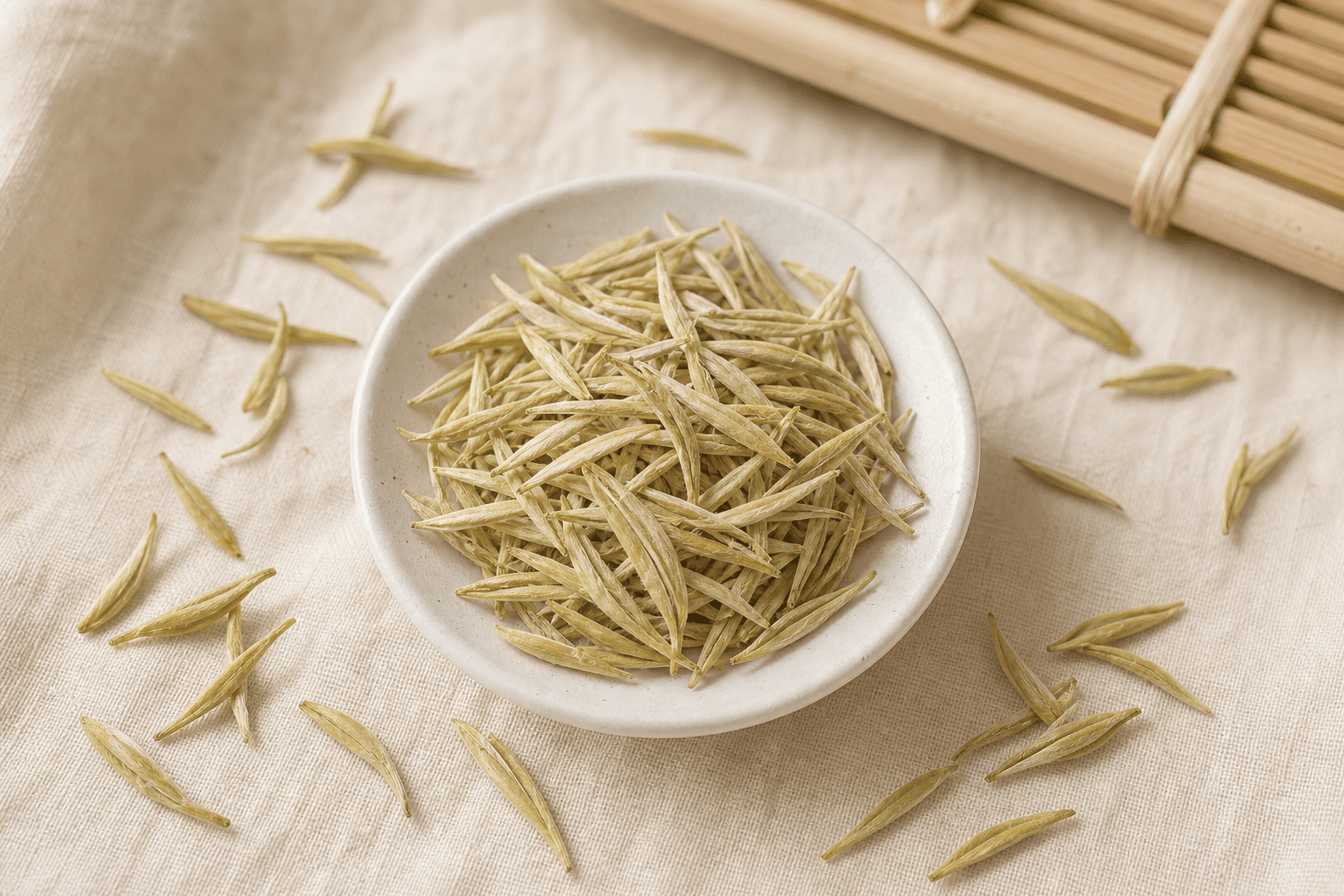
Anji Bai Cha sits inside one of the more useful confusions in Chinese tea. The name reads "Anji white tea", but the leaf is processed exactly like a green — pan-fired or lightly steamed within hours of plucking, then shaped into flat needles the locals compare to sparrow tongues. The white in the name belongs to the cultivar, not the method. Bai Ye 1 — the mother bush traced to a single tree found on Tianhuangping mountain in 1982 — produces leaves so pale in early spring they look bleached, almost translucent.
The pallor is temperature-driven. When the cultivar flushes below about 23°C, chlorophyll synthesis stalls and the new leaf emerges yellow-white, with amino acids — L-theanine especially — at concentrations roughly twice those of an ordinary green tea. The window is short. By late April the leaves green up, the chemistry rebalances, and the harvest closes for the year. What ends up in the tin is the work of three weeks and a careful hand at the wok.
History & Origins
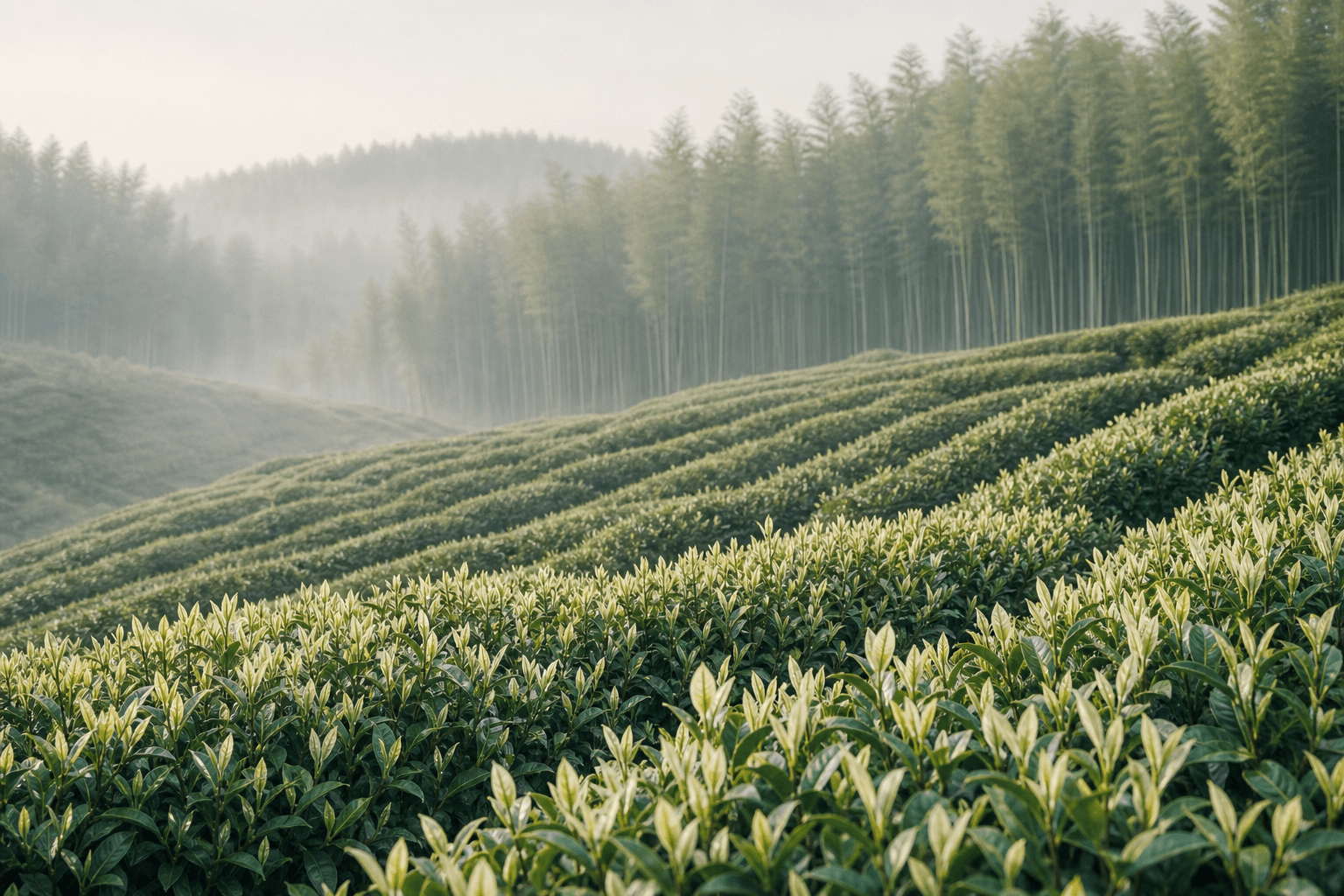
Anji County sits in the northern hills of Zhejiang, better known to most Chinese travellers as the bamboo sea — vast groves of moso bamboo that fill the valleys and climb the slopes. Tea was always grown here at small scale, but the modern Anji Bai Cha story begins in 1982, when a single ancient tea tree was found high on Tianhuangping mountain producing albino-white spring leaves. Cuttings from that tree, propagated through the late 1980s, became the Bai Ye 1 cultivar that now defines the appellation.
The cultivar is genetically green tea — Camellia sinensis var. sinensis — but it carries a temperature-sensitive mutation that suppresses chlorophyll in cool weather. References to a "white tea from Anji" appear as early as the Song dynasty: Emperor Huizong, in his 1107 treatise Daguan Chalun, mentions a rare white-leaved tea from the Zhejiang hills as the most precious of all. Whether the surviving 1982 tree is a literal descendant of that lineage or a parallel mutation is a question still argued in Chinese tea-science journals.
Production scaled quickly through the 1990s and Anji Bai Cha became one of China's twenty protected geographical-indication teas. Today the harvest is concentrated in the three weeks around Qingming, when the leaves are at their palest and the amino-acid load at its peak. Outside the window the same bushes produce ordinary green tea — but it is the brief albino flush that the county is known for, and that the careful drinker is paying for.
Flavor
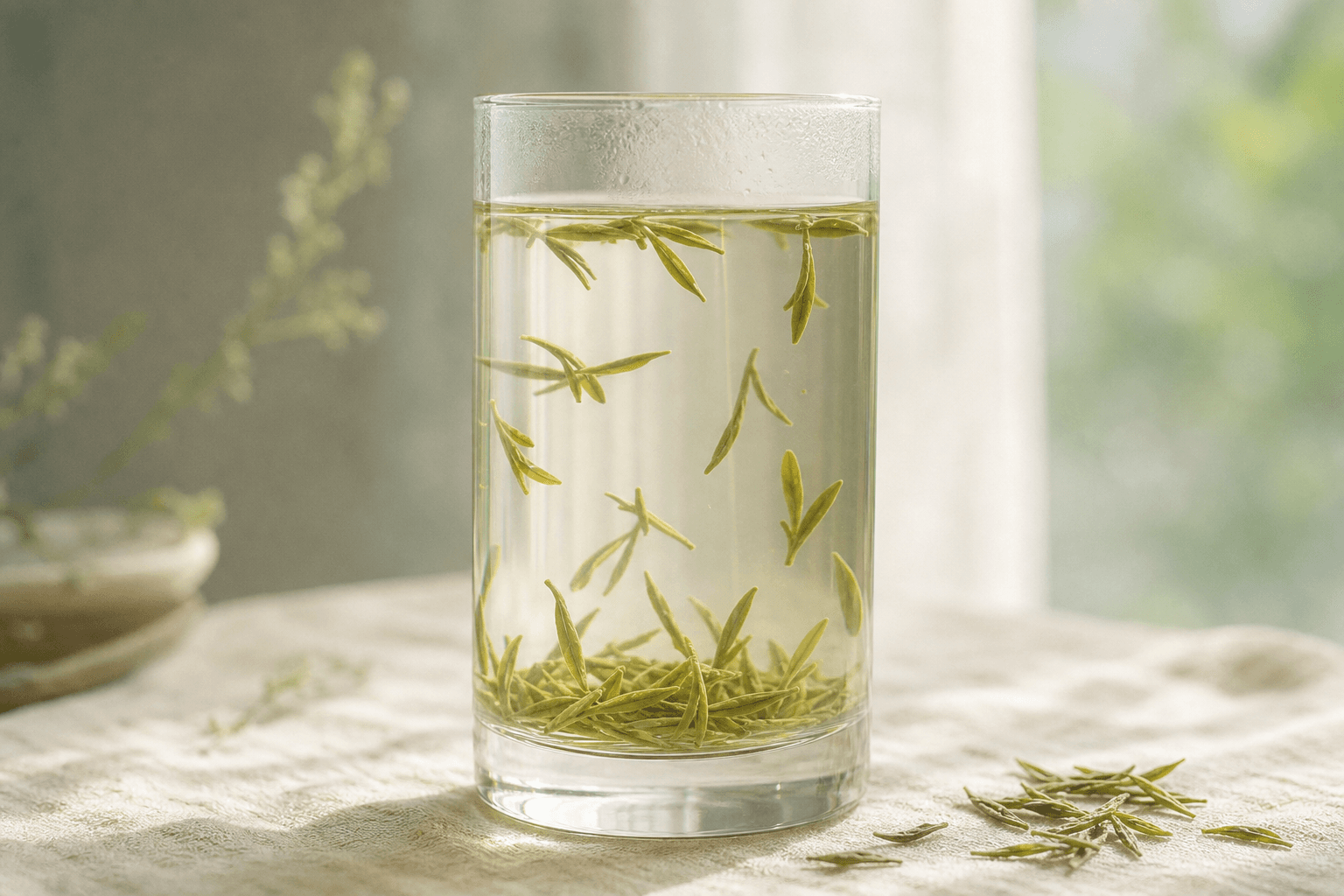
Anji Bai Cha asks for cooler water than most greens. Pour 80°C onto four grams of leaf in a tall glass tumbler — no rinse, no gaiwan necessary — and watch the pale flat needles drift, then sink, then unfurl one by one along the bottom. The liquor pours a luminous pale jade, almost colourless against white, with a faint silvery sheen.
The first cup is the one to wait for. Across two or three steeps the tea opens into something far more savoury than its colour suggests — a clean vegetal sweetness with a real broth-like weight on the palate, the signature of a leaf carrying twice the usual amino-acid load. By the third infusion the umami softens and a fresh-grass top note takes over; by the fourth the cup turns watery and gentle, but never bitter, even if the leaves sit too long.
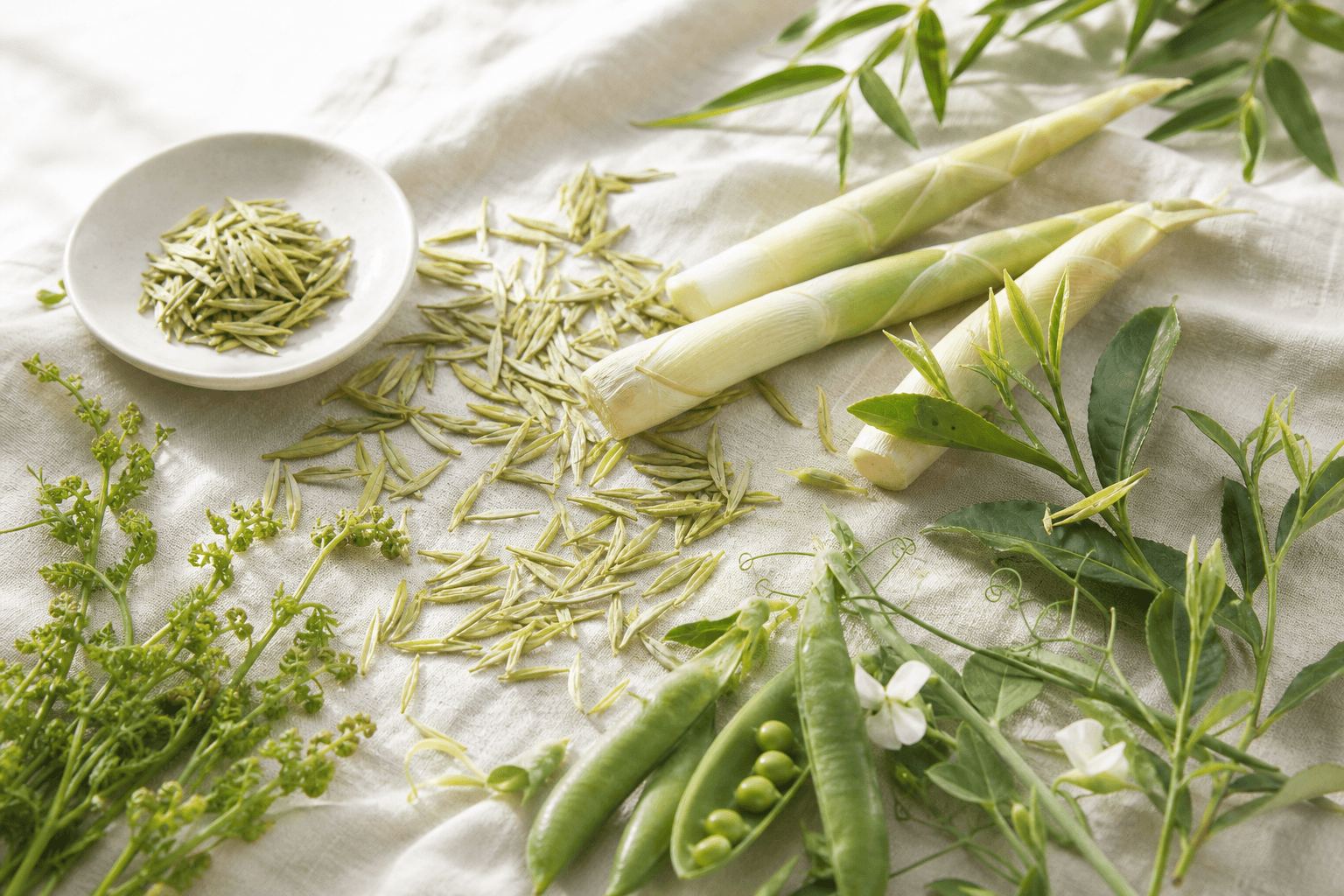
Surprisingly broth-like — a savoury umami sweetness coats the tongue, gentle as miso water, threaded with spring grass, snow pea, and a faint honeydew lift in the middle.
Cooling and softly sweet, with no astringency and no bitterness even at length. The amino acids leave a quiet salivary brightness that settles into a long, clean breath.
Across the session
Pale liquor, leaves still suspended; the cup is delicate and faintly sweet.
Umami opens fully — the savoury, edamame-rich heart of the session.
Fresh spring grass and snow pea take the lead as the umami softens.
Watery, gentle, faintly sweet — no bitterness, just a clean tail.