Fragrant · Golden · Smooth
Tieguanyin oolong scented with golden osmanthus blossoms harvested in Guilin. Each infusion releases waves of stone fruit and honeyed florals, deepening with every steep.
Brewing Guide
In Traditional Chinese Medicine, osmanthus is a warming, qi-moving flower — said to disperse cold from the lungs and stomach, support digestion, and lift the mood when the season turns. It appears in the pharmacopoeia as gui hua, paired with ginger for cold patterns and with tea for what older texts simply call "brightening the spirit." Tieguanyin, a partially oxidized oolong, is considered neutral to mildly warming — gentler on the stomach than green tea, less heating than a roasted black, and traditionally drunk through the day without disturbing sleep.
Modern phytochemistry reads the pairing in its own vocabulary. Osmanthus blossoms are rich in linalool, β-ionone, and γ-decalactone — the same lactone family that gives apricots their scent — alongside flavonoids studied for antioxidant and anti-inflammatory activity. Oolong leaf carries a mid-range catechin profile and a distinctive load of theaflavins and polymerized polyphenols formed during partial oxidation. None of this is a medical claim — but it does explain why the cup feels both lifting and steadying at once.
Tradition
Gui hua is the classic mid-autumn flower — drunk to lift heaviness, brighten the spirit, and mark the turning of the season.
Modern lens
Linalool and β-ionone are studied for their effects on relaxation and olfactory mood pathways; aromatic teas show measurable shifts in stress markers.
Tradition
Oolong is the tea long drunk in southern China to "cut the grease" — paired with rich autumn meals to ease the stomach.
Modern lens
Partially oxidized oolong is associated in studies with improved fat oxidation and modest effects on lipid handling, distinct from green or black tea.
Tradition
Osmanthus warms the middle and disperses cold — taken after meals to ease bloating and support the spleen and stomach.
Modern lens
Aromatic terpenes and flavonoids in osmanthus are studied for gentle prokinetic and antispasmodic effects on the digestive tract.
Tradition
Tea and flower together were considered "preserving" — drunk through the dry autumn months to keep the body bright.
Modern lens
Theaflavins from oxidized oolong and phenolic compounds from osmanthus blossoms together cover a wide spectrum of antioxidant activity in vitro.
The Tea
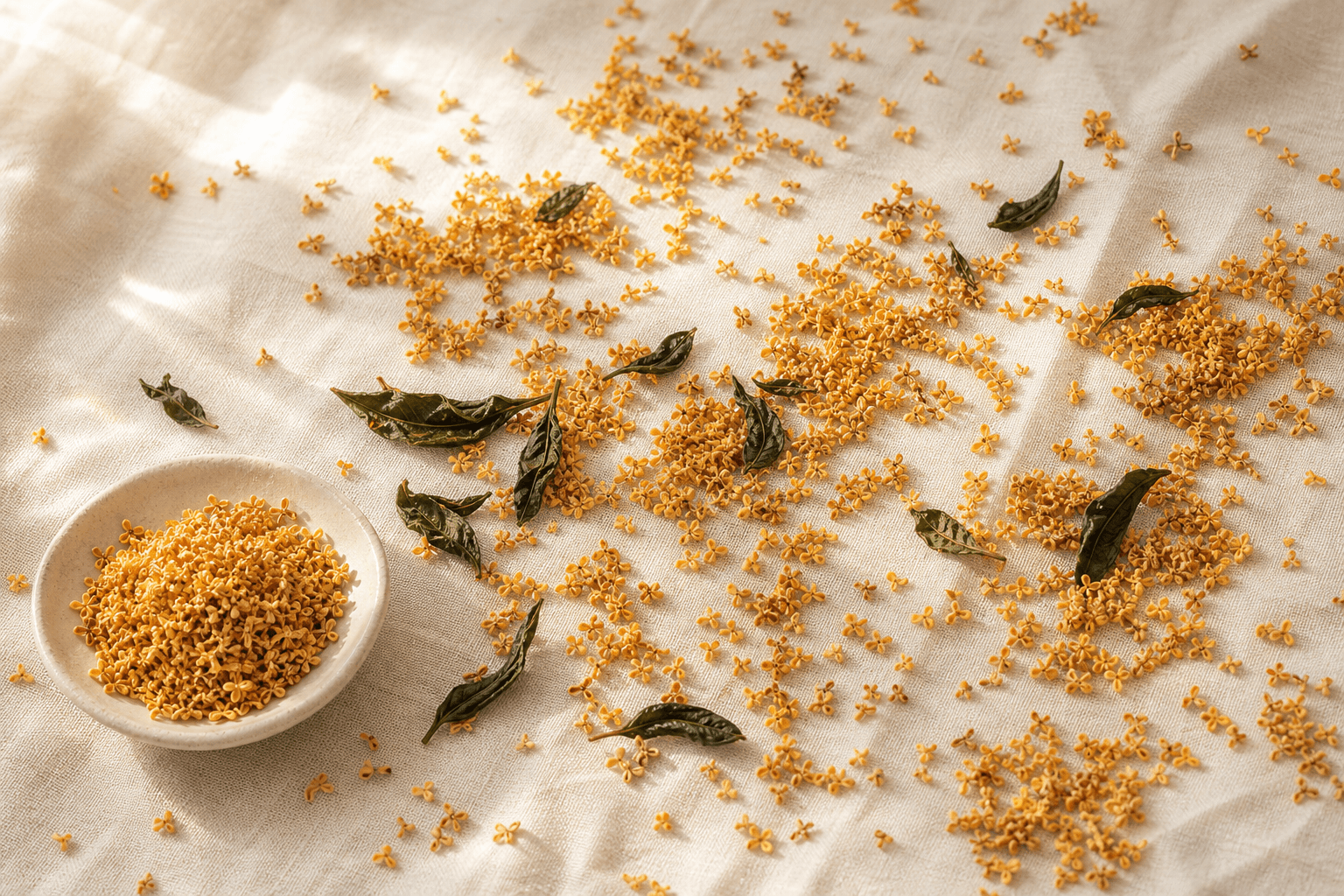
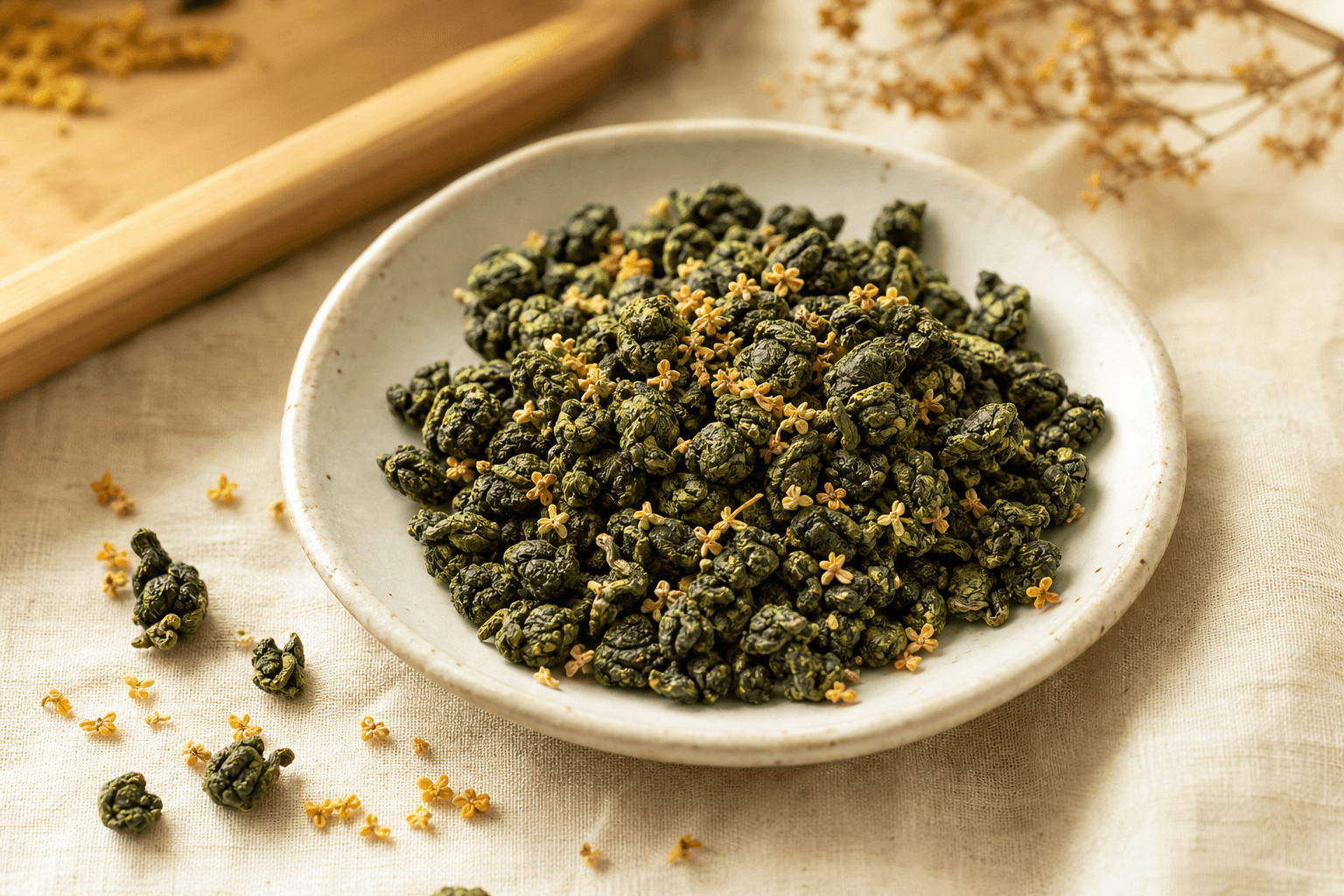
Osmanthus Oolong begins with Tieguanyin from Anxi, the rolled jade-green oolong that carries Fujian's most recognizable cup. The leaves are the autumn pluck — denser, more aromatic, slightly less vegetal than the spring crop — chosen because they have the structure to hold a second perfume without collapsing under it. The accent is gui hua: tiny golden osmanthus blossoms from Guilin in Guangxi, bloomed for a few short weeks each autumn and dried within hours of harvest to lock in their stone-fruit sweetness.
Scenting follows the same patient logic as a fine jasmine. Fresh blossoms are layered through warm tea overnight, then sieved out at dawn; the process repeats over three to four nights with new flowers each pass, until the leaf has drunk in the perfume without going stale. A small scatter of dried blossoms is folded back through the finished tea — for fragrance in the dry leaf and for the eye, not because the cup needs more.
History & Origins
Tieguanyin — "Iron Goddess of Mercy" — has been made in Anxi County, Fujian, since the early eighteenth century. The story credits a poor farmer named Wei who tended a neglected shrine to Guanyin and was rewarded with a single tea bush that produced a leaf "heavy as iron" with a long mineral finish. Whatever the origin, the cultivar and its rolling style — partial oxidation, then slow shaping into tight emerald orbs — have defined Fujian oolong for three centuries.
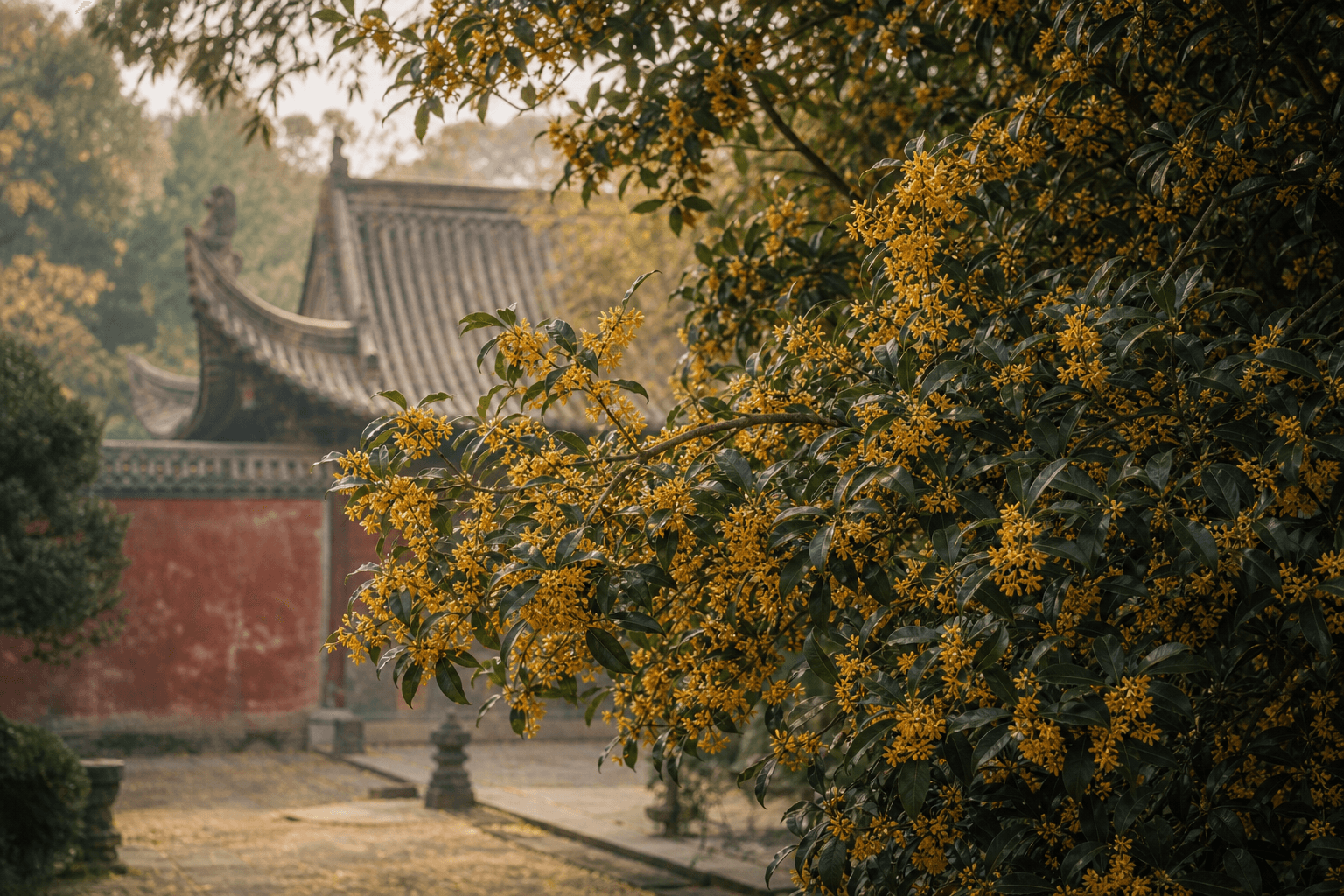
The osmanthus tradition runs along a different axis. Gui hua, the sweet osmanthus tree, blooms for a brief window in autumn across southern China, and its tiny golden flowers carry an apricot-peach-honey perfume that has perfumed Chinese poetry since the Tang. Guilin — whose very name means "osmanthus forest" — has been the prized source for over a thousand years; the city's old courtyards still drift with the scent every September. The flower is woven through Mid-Autumn Festival: gui hua wine, gui hua cakes, gui hua tea, all marking the moon's full turn.
Pairing the two is a southern teahouse innovation, refined in the twentieth century once dried-flower scenting techniques perfected by jasmine makers were applied to other blossoms. Tieguanyin's orchid-cream base proved an unusually generous host for osmanthus — its mineral spine carries the perfume without smothering it. The blend has stayed in the repertoire because it sounds like one tea, not two.
Flavor
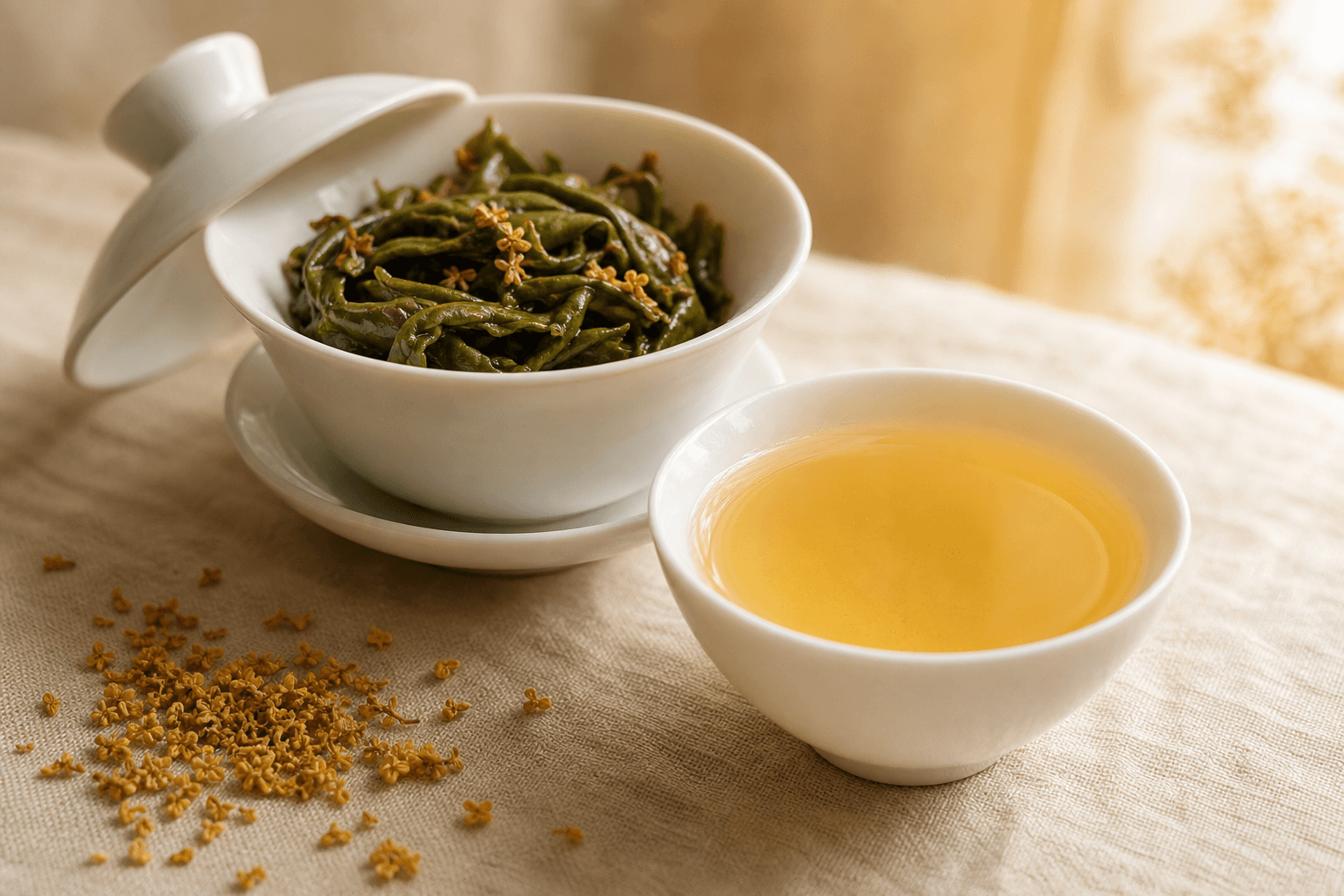
Brew at 90–95°C — a touch cooler than a green oolong, hot enough to open the rolled leaf without scorching the blossom oils. Five grams to a hundred-millilitre gaiwan, a fast rinse to wake the orbs, then a twenty-second first pour. The liquor arrives pale gold with a clean luster; the dry-leaf perfume of warm peach and honey lifts off the wet leaf as soon as the lid comes off.
Across six or seven steeps the cup widens. Early infusions lead with osmanthus — apricot, gardenia, a faint butter note — over the tieguanyin's creamy orchid base. By the third pour the oolong has fully unfurled, showing its mineral length and the cooling lilac-and-green-apple finish that Anxi leaf is known for. Later steeps surrender the perfume entirely and let the base tea finish the session on its own terms.
Silky and round across the tongue, with stone-fruit sweetness up front, an orchid-cream middle, and a quiet mineral spine that keeps the perfume from going syrupy.
Long and cooling, faintly of lilac and green apple skin, with the osmanthus returning on the breath a beat after the cup is set down.
Across the session
Osmanthus forward — apricot and honey over the just-loosening leaf, the sweetest cups of the session.
Tieguanyin opens fully; orchid and butter rise underneath, perfume and base in balance.
Perfume recedes; the oolong's mineral length and lilac finish take the cup.
Soft, sweet, water-clear — a long cooling tail with the faintest osmanthus echo.