Cooling · Bright · Honeyed
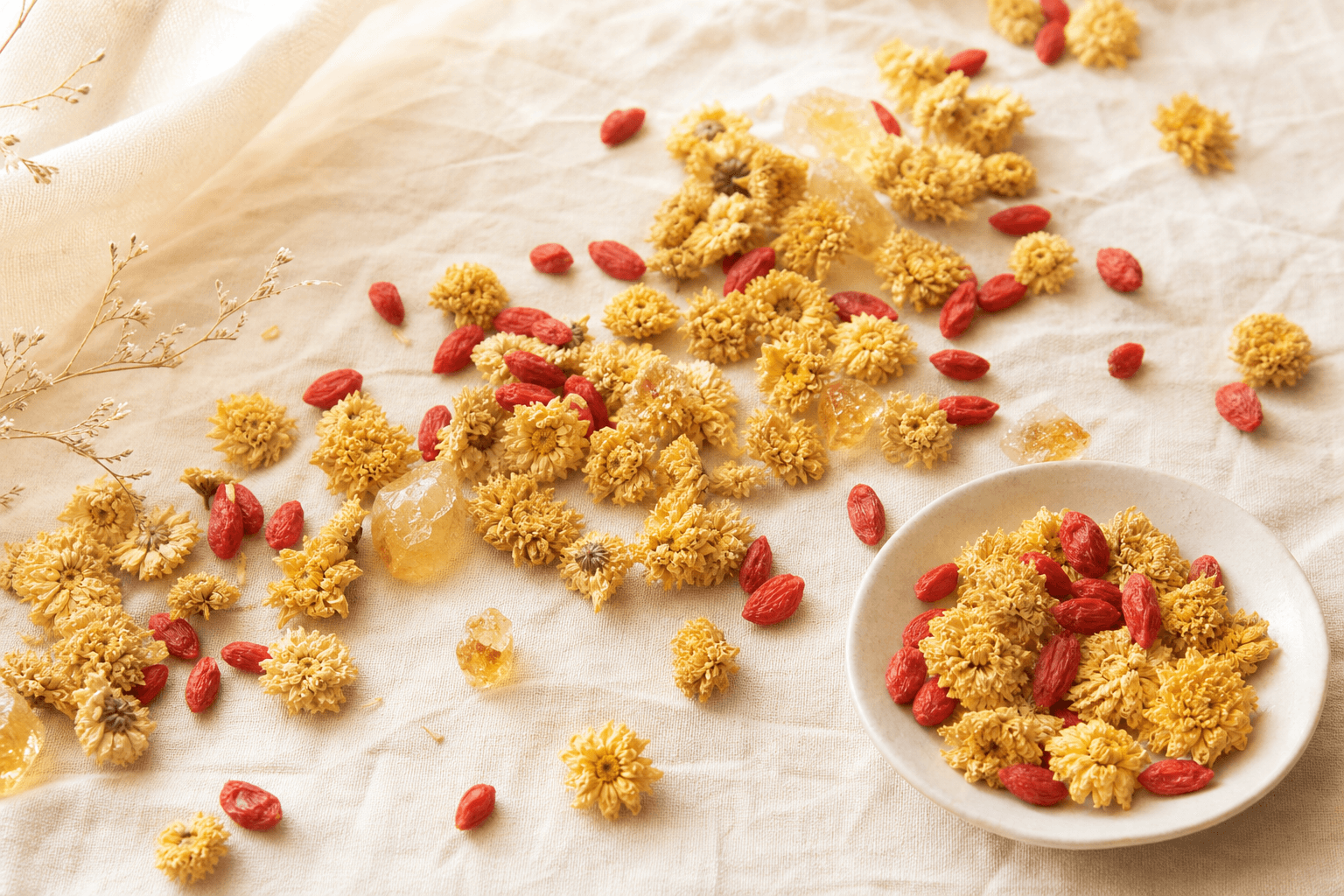
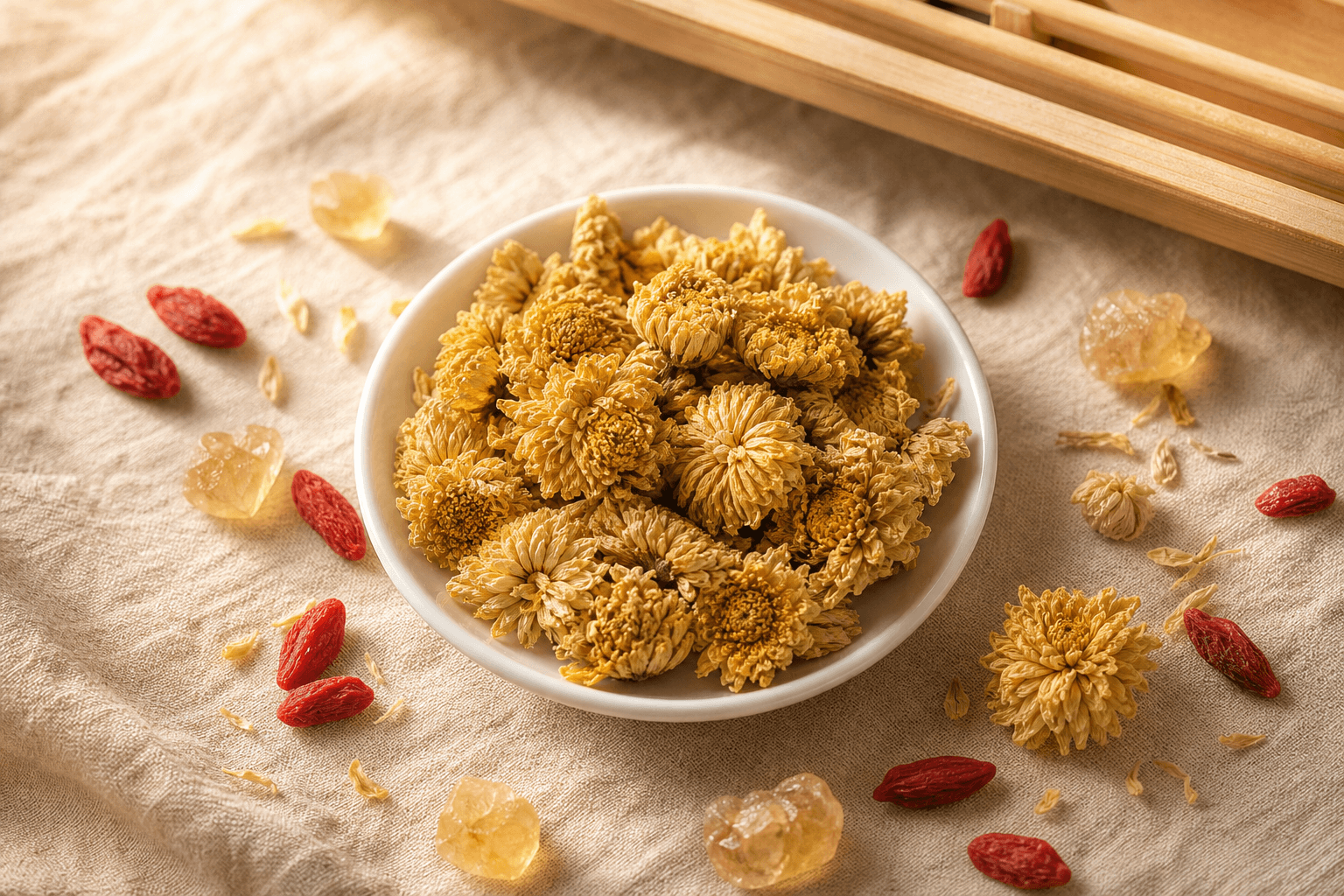
Golden chrysanthemum from Hangzhou paired with rock sugar and goji berries. A cooling, restorative tisane beloved for centuries as a remedy for summer heat and tired eyes.
Brewing Guide
In Traditional Chinese Medicine, chrysanthemum (ju hua) is classified as cooling — xing han — with an affinity for the liver and lung channels. The classical materia medica prescribe it for shang huo, the constellation of "rising heat" symptoms that includes irritability, headache, and the dry, gritty eyes that come from long reading or summer sun. Goji berries (gou qi zi) are considered warming and tonifying, especially for liver-blood and the eyes; rock sugar harmonizes the cup. The combination is one of the oldest examples of TCM's preference for balance: cooling herb, warming fruit, gentle sweetness.
Modern phytochemistry finds chrysanthemum unusually rich in luteolin, apigenin, and chlorogenic acid — flavonoids studied for anti-inflammatory and antioxidant activity. Goji berries are heavy in zeaxanthin, the carotenoid that concentrates in the macula of the eye. None of this is a medical claim — but the long folk use of this cup for tired eyes lines up surprisingly well with what the lab finds in the ingredients.
Tradition
Drunk for centuries to ease tired, dry, gritty eyes — the scholar's cup for long reading sessions and the screen-weary modern equivalent.
Modern lens
Goji berries are unusually rich in zeaxanthin, the carotenoid that concentrates in the macula; chrysanthemum carries luteolin, studied for ocular protection.
Tradition
Classified as xing han — cooling — and reached for in summer heat or after spicy meals to settle "rising fire" and irritability.
Modern lens
Chrysanthemum infusions are associated in early studies with mild vasodilatory and antipyretic effects, fitting the cup's reputation as a heat-clearer.
Tradition
Caffeine-free and traditionally taken in the late afternoon or evening to ease frustration and the heat of a difficult day.
Modern lens
Apigenin, abundant in chrysanthemum, has been studied for its mild anxiolytic activity at GABA receptors — gentler than chamomile but in a similar register.
Tradition
Said in TCM to clear stagnant liver heat and brighten the eyes — a daily cup through the long humid summers of Jiangnan.
Modern lens
Chlorogenic acid and the luteolin-apigenin pair are studied for hepatic anti-inflammatory activity; phytochemistry that maps onto the older framing.
The Tea
Chrysanthemum Blend is a caffeine-free tisane built around Hang Bai Ju — the small, golden-petalled chrysanthemum cultivar (Chrysanthemum morifolium) that Hangzhou growers have prized for centuries. The blossoms are picked just as they open, then slowly air-dried so the petals keep their honeyed sweetness and pale gold edge. To them we add a quiet measure of Ningxia goji berries and a few amber crystals of Chinese rock sugar.
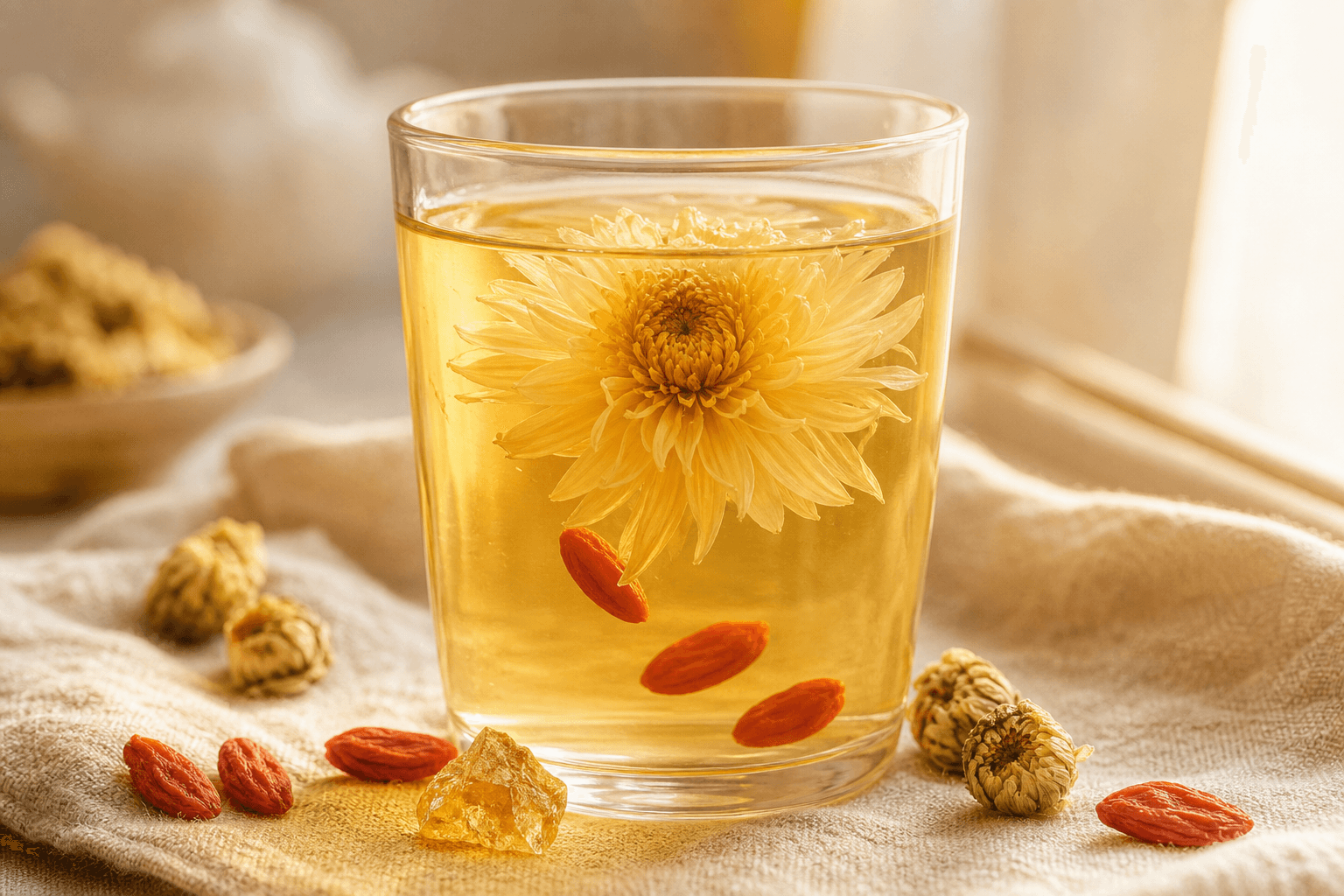
The proportions are deliberately restrained. Five or six dried flowers per cup, a small handful of goji, a single rock-sugar shard — enough to round the cup without sweetening it flat. The blend rests for two weeks after assembly so the goji can lend its faint date-like sweetness to the dry blossoms before tinning. Brewed in clear glass, the dried flower opens fully in the cup, the way it was always meant to be drunk.
History & Origins
Chrysanthemum was already a cultivated plant in China by the Tang dynasty, mentioned in poetry and pressed into wine for the Double Ninth festival long before it was steeped as tea. The Shen Nong Ben Cao Jing — the foundational Han-era materia medica — lists ju hua among its upper-tier medicinals, classified as cooling and friendly to the eyes and liver. Drunk as an infusion, it spread through the Song and Ming as both a domestic remedy and a scholar's cup, taken in the heat of late summer when stronger teas felt too warming.
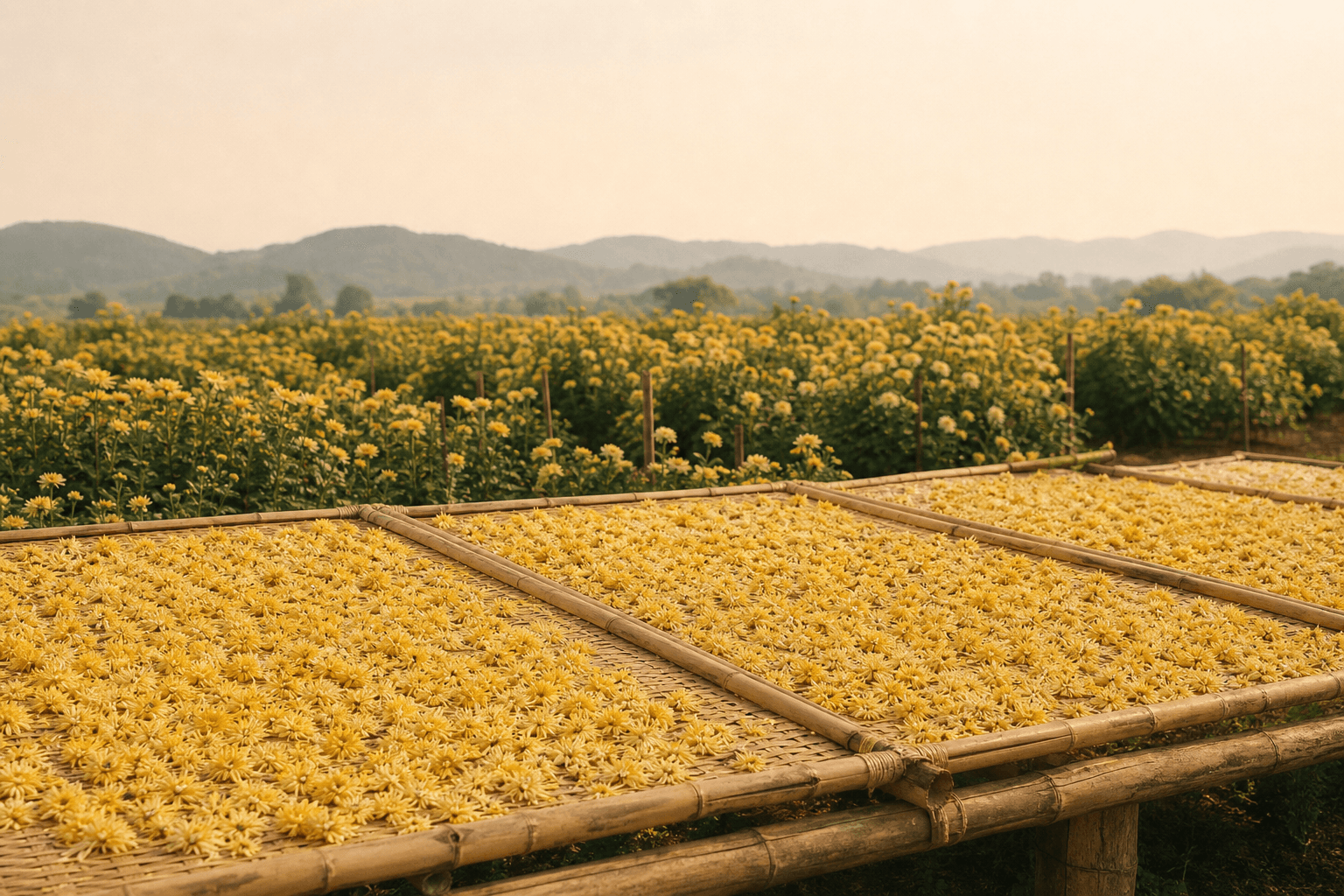
Of the many cultivars grown across China, Hangzhou's Hang Bai Ju is the most prized. The fields cluster in Tongxiang and the surrounding plain west of the city, where mild autumns and the soft alluvial soil of the lower Yangtze produce a smaller, denser blossom with concentrated aromatics. The flowers are harvested in late October and early November, then either steamed and sun-dried or slowly air-dried on bamboo mats — the latter method, more labor-intensive, preserves the pale golden centre that drinkers learn to look for in the dry flower.
The pairing with rock sugar and goji is southern and domestic rather than ceremonial. Cantonese and Jiangnan households drink the cup year-round but reach for it most in summer, after rich meals, or when eyes are tired from long reading. Goji rounds the slight bitterness of the petals; rock sugar lifts the floral note without flattening it. The cup endures because it is gentle, useful, and honest — a tisane that has been in continuous daily use for more than a thousand years.
Flavor
Brew this one in glass — a tall heat-safe tumbler or a clear gaiwan — because the visual is half the cup. Drop five or six dried blossoms into the vessel with a few goji berries and one shard of rock sugar, then pour 95–100°C water over the top. In the first thirty seconds the flowers swell and unfold, the goji plumps and sinks, and the liquor turns pale yellow, then deepens to honey-gold over three to five minutes.
Unlike a leaf tea, the chrysanthemum cup doesn't cycle through dramatic infusions. A single brew holds steady for ten or fifteen minutes; a second pour onto the same flowers gives a softer, sweeter cup as the goji finally surrenders its sugars. Drink it hot in winter or chilled over ice in summer. Either way, the flower stays fully bloomed in the cup until the last sip.
Light-bodied and clear, with the sweetness of goji settling in the middle and a gentle herbal bitterness from the petals that keeps the cup from going syrupy.
Cool and lingering, faintly mineral, with the rock sugar pulling the floral notes long across the breath. The cup leaves the mouth feeling rinsed.
Across the session
The dried flowers swell and open; the liquor pales to soft yellow as the petals release.
Color deepens to honey-gold; goji sweetness arrives and the floral note rounds out.
The cup holds — light bitterness balances sweetness, drinkable hot or left to cool.
A second water gives a quieter, sweeter cup as the goji finally gives up its sugars.