Delicate · Sweet · Jasmine
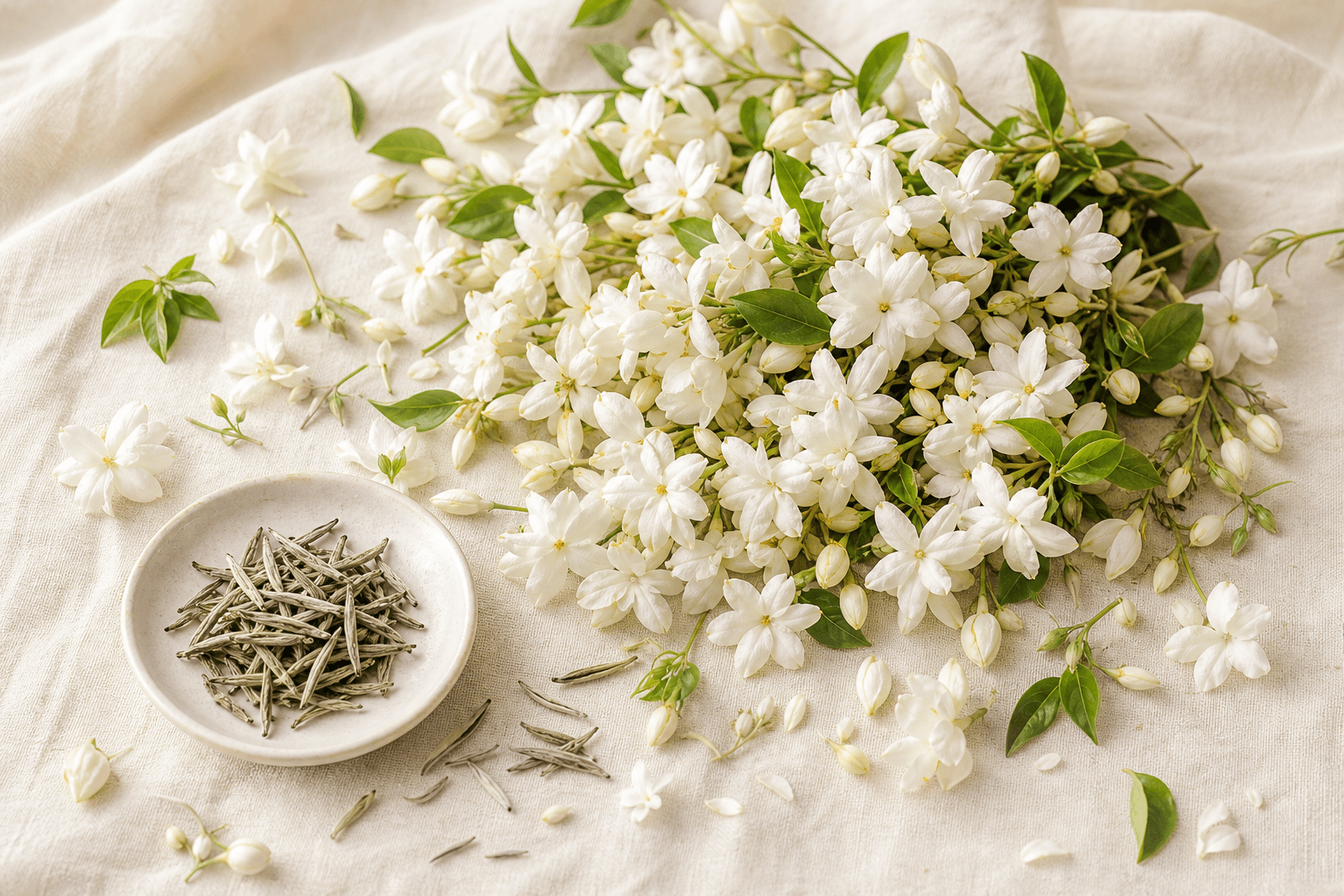
Premium Bai Hao Yinzhen scented seven times with fresh jasmine blossoms. The result is ethereal — barely there sweetness, pure floral perfume, and a finish like morning dew.
Brewing Guide
In Traditional Chinese Medicine, white tea is regarded as cooling — a yin-leaning cup said to clear summer heat, ease a dry throat, and calm a hot temperament. Bai Hao Yin Zhen, made only of buds, is considered the most refined expression of that character: gentle on the stomach, suitable for late afternoon, traditionally pressed on convalescents and elders. Jasmine in the TCM frame is mildly warming and qi-moving, said to soothe tension and lift a heavy spirit, which is why the scented tea reads as both cooling and quietly uplifting.
The modern picture lines up with the old one in interesting places. Silver-needle white tea carries unusually high levels of catechins and L-theanine relative to other teas — the buds are the youngest growth, where these compounds concentrate — and sambac jasmine contributes linalool and benzyl acetate, aromatics studied for their effect on the parasympathetic nervous system. None of this is a medical claim — but the calming, focused quality drinkers report has more behind it than tradition alone.
Tradition
White tea is taken in the late afternoon for a cup that wakes the mind without disturbing the body — the scholar's tea, drunk over long reading.
Modern lens
Silver-needle is rich in L-theanine, an amino acid associated with alpha-wave brain activity and a calm, attentive state when paired with mild caffeine.
Tradition
Drunk through summer to clear inner heat and brighten complexion; pressed cooled bud-water has been used as a face rinse in Fujian households.
Modern lens
Among the highest catechin and polyphenol concentrations of any tea — studied for free-radical scavenging activity and effects on collagen at the cellular level.
Tradition
A cooling cup said to soothe a dry throat and the heaviness of summer air; jasmine is considered qi-moving, lifting tightness in the chest.
Modern lens
Linalool and benzyl acetate — the dominant volatiles in sambac jasmine — are studied for mild bronchodilatory and parasympathetic effects.
Tradition
Mo li hua tea has been drunk for centuries to ease a sad heart and lift a heavy spirit — the cup brewed when company is wanted but words are not.
Modern lens
Inhalation of jasmine aromatics is associated in small studies with reduced cortisol and a measurable shift toward parasympathetic dominance.
The Tea
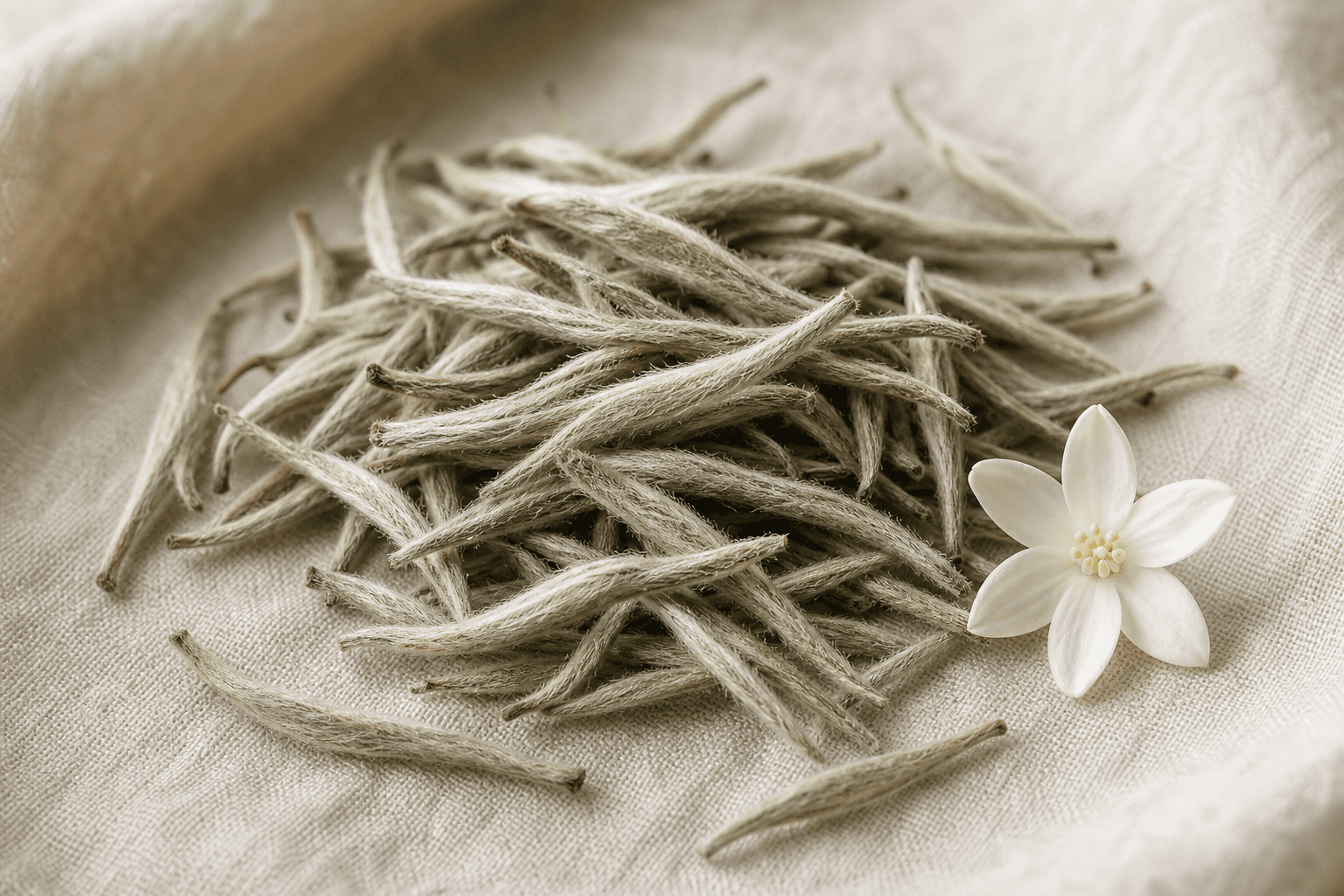
Jasmine Silver Needle begins as Bai Hao Yin Zhen — "white hair silver needle" — the most rarefied grade of white tea, made entirely from unopened spring buds plucked in the hills around Fuding, Fujian. Each bud is sheathed in a fine silver down, the bai hao that gives the tea its name and its weightless, cool-cotton mouthfeel. There is no leaf in the cup, only the new growth itself: a few hundred buds for every gram, picked over a window of perhaps ten days each spring.
The scenting is its own slow craft. Across seven consecutive summer nights, the dried buds are layered with fresh jasmine blossoms harvested at dusk and brought in just before they open — the moment they release their aromatics is the moment the tea drinks them in. Each morning the spent flowers are sieved out and the buds rest; each evening a fresh batch of blossoms is laid in. By the seventh pass the buds carry the perfume of a summer garden without a single petal left in the tin.
History & Origins
White tea as we know it traces to the early nineteenth century in Fuding County, on the northeastern coast of Fujian, where the local Da Bai cultivar — its buds unusually plump and densely furred — proved ideal for the simplest of all tea processings. The buds are withered in long, sun-and-shade rotation across bamboo trays, then dried gently. Nothing is rolled, nothing is fired hard. The cultivar and the wither do almost all of the work, which is why provenance matters so much in a tea this minimal.
Jasmine's arrival in Chinese tea culture is older and runs through Fuzhou, the Fujian capital just south of Fuding. Mo li hua, the small white sambac jasmine, came along the maritime trade routes and was being cultivated commercially around Fuzhou by the Song dynasty; by the Ming, jasmine-scented tea had become a tribute item. Fuzhou's humid summers and its proximity to the white-tea hills made it the natural place for the two crafts to meet.
The seven-scenting silver needle is the apex of that meeting. Pairing the most delicate base tea in China with the most volatile of flowers is unforgiving — coarser teas would mask the jasmine, heavier flowers would crush the buds — so the work is reserved for the best lots of each. What lasts in the cup is not flavor borrowed but flavor absorbed: the buds remember the flowers long after they have been carried away.
Flavor
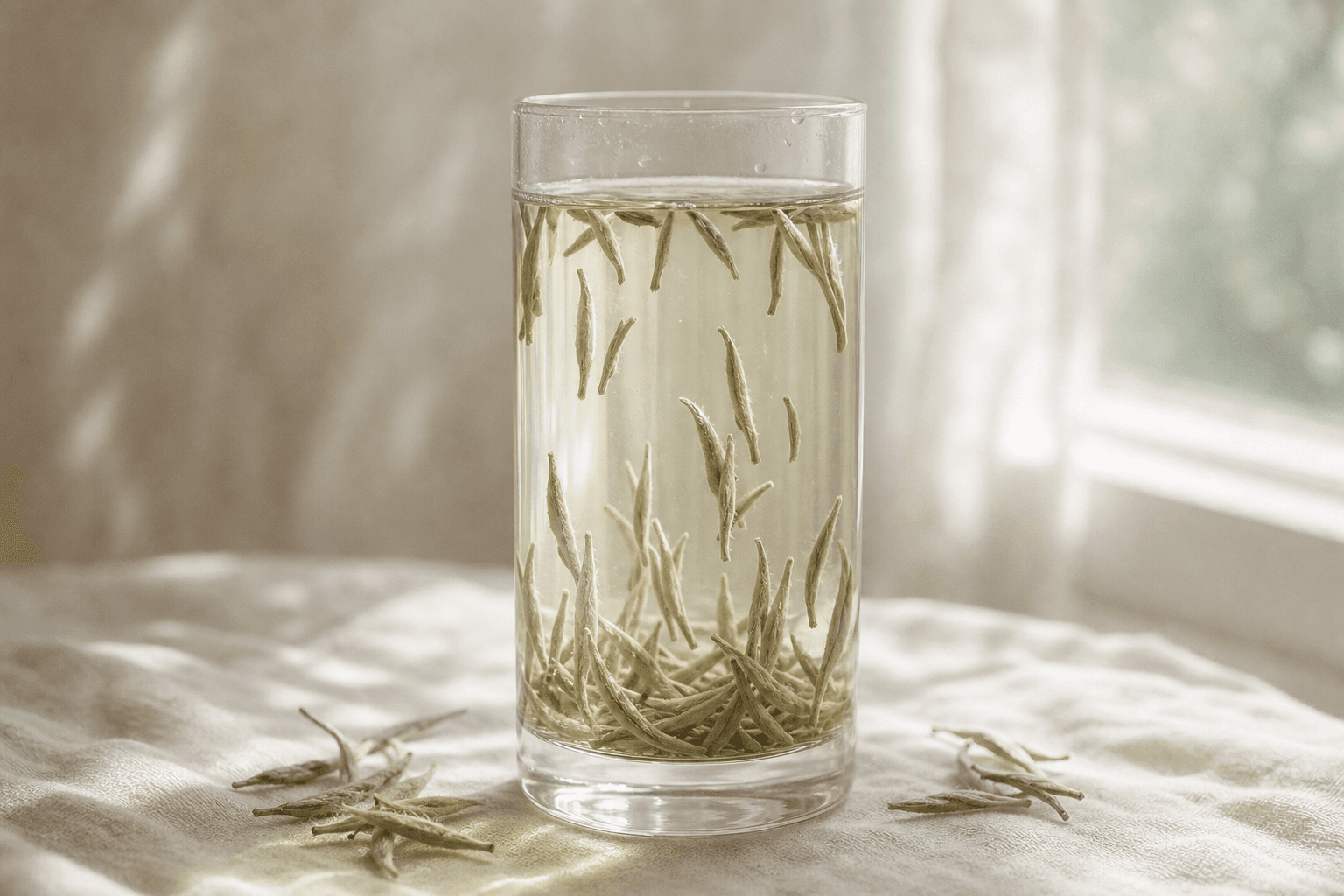
This is one of the most delicate brews in the Chinese repertoire and it asks for restraint. Pour 80–85°C water onto four grams of buds in a tall clear glass tumbler — no rinse — and watch them dance and slowly settle. The liquor arrives almost colorless, brightening across two or three minutes into a pale champagne-yellow with the faintest green cast. Lean over the cup and the jasmine is already there, lifting in the steam.
Across four or five infusions the cup unfolds rather than evolves. The opening pour is all perfume — soft, cool, almost watery in body. By the second steep the white tea's own character emerges underneath: melon rind, fresh hay, a whisper of honeysuckle. By the fourth, the jasmine has retreated to a memory and what is left is the bare, sweet bud. The whole session is hushed, and the room quietens around it.
Weightless and silken, almost watery in the best sense; sweetness arrives soft and slow, like dew on melon rind, with no astringency and no green edge.
Cooling and clean, with a long quiet aftertaste of floral steam — the kind that stays on the breath after the cup is gone, neither sugary nor sharp.
Across the session
Pure jasmine perfume over a near-colorless liquor — the lightest, most aromatic cup of the session.
The white tea wakes — melon rind, fresh hay, honeysuckle settling beneath the floral lift.
Jasmine recedes; the bud's own cool sweetness carries the cup.
Soft, water-light, faintly sweet — a final whisper before the buds fall silent.