Floral · Fruity · Tippy
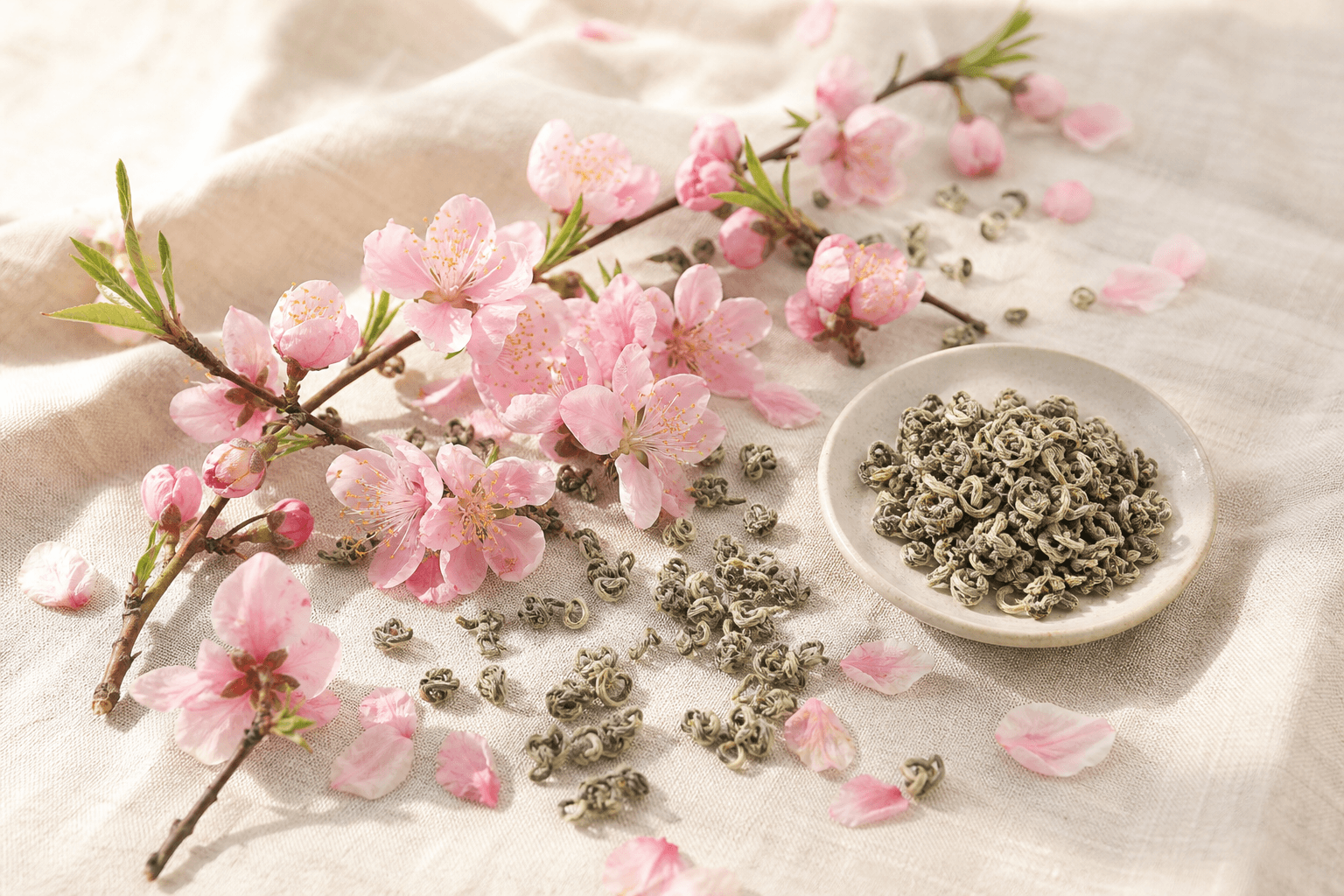
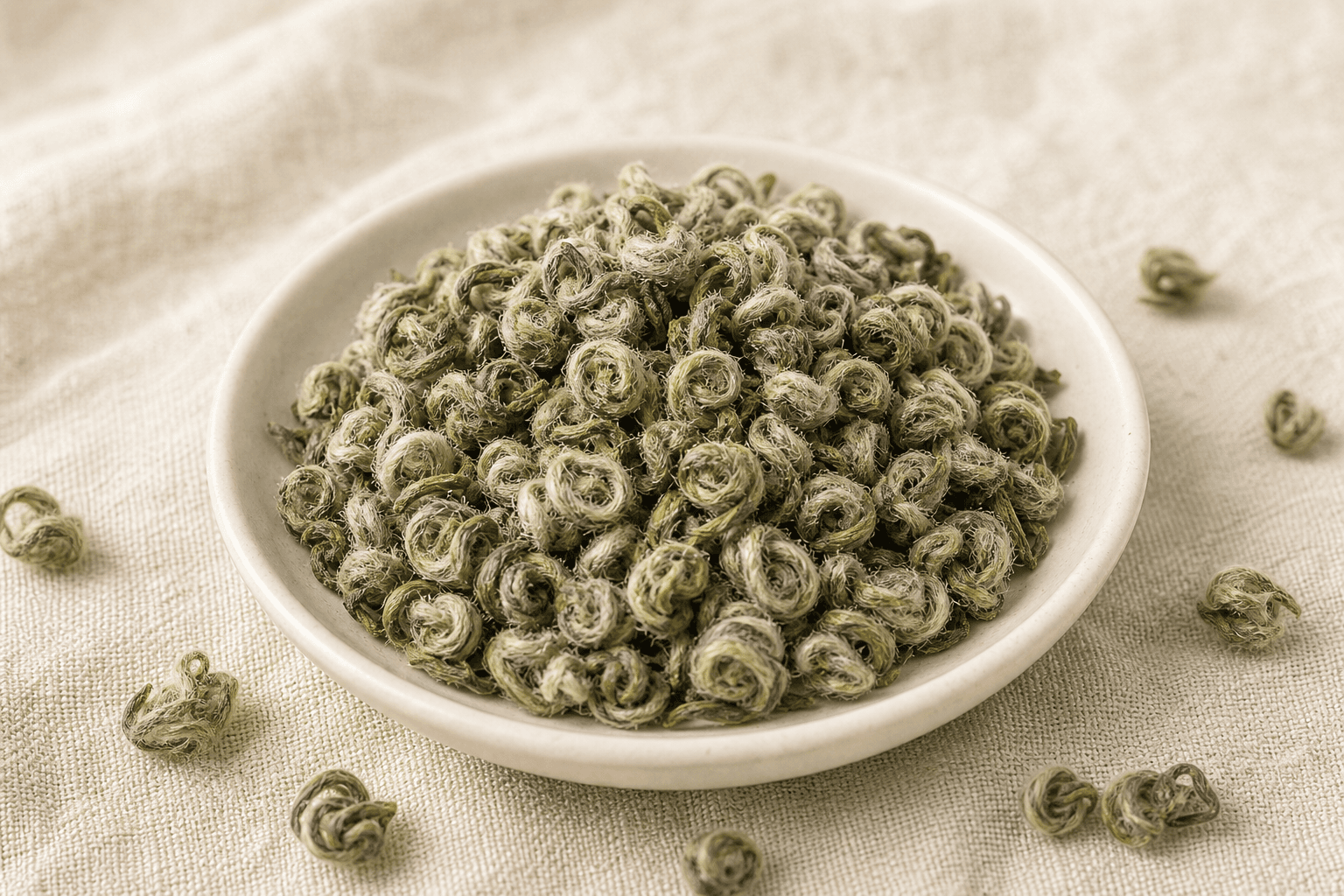
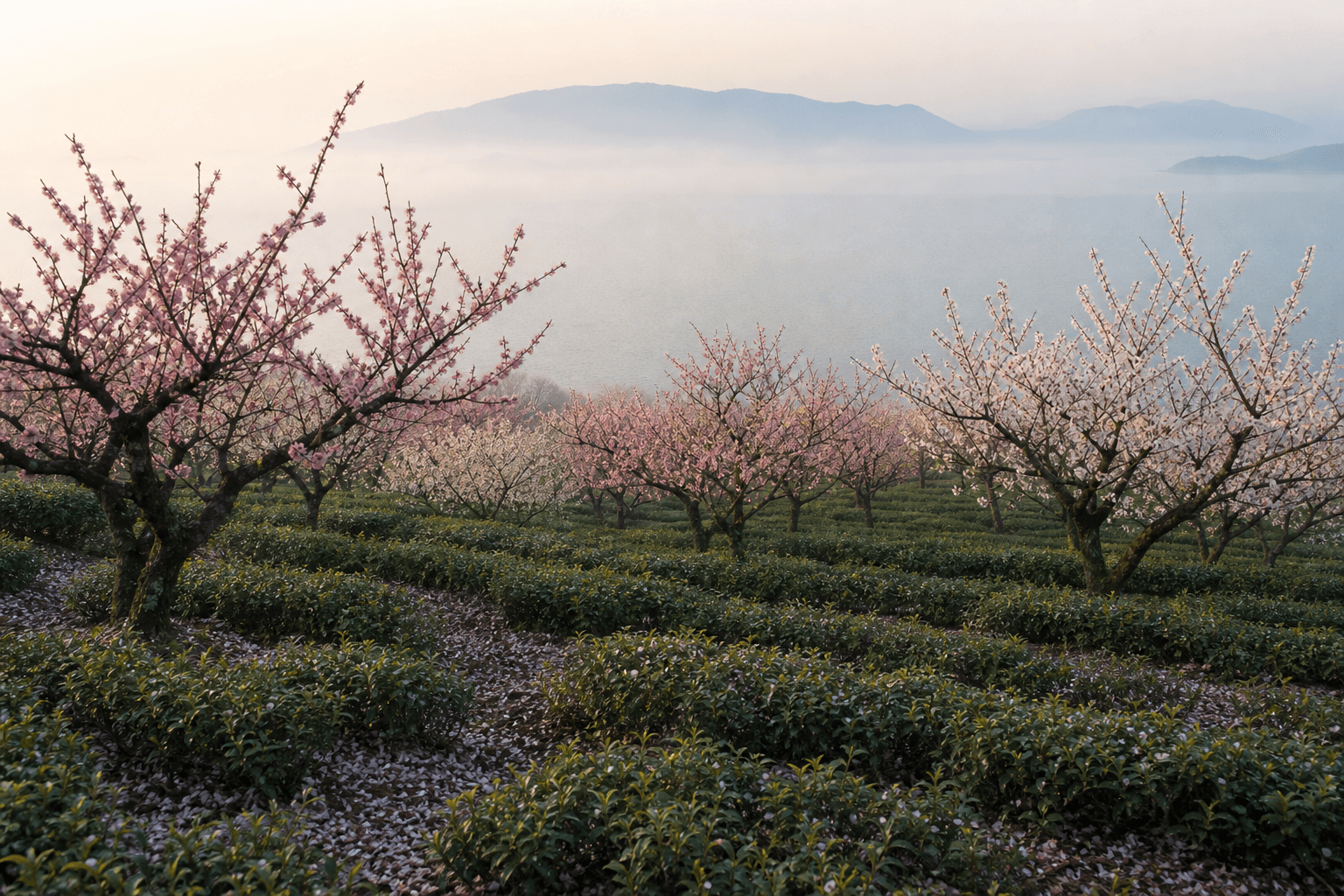
"Green Snail Spring" — tightly curled tippy leaves grown between peach and plum orchards on Dongting Mountain in Lake Tai. The fruit trees lend a subtle stone-fruit fragrance to the cup; the downy buds give a velvet body.
Brewing Guide
In the Suzhou tradition, Bi Luo Chun is the tea drunk to wake the body out of winter — early spring picking, cool nature, clearing rather than warming. Classical Chinese medicine reads the cup as cooling and slightly bitter-sweet, said to clear summer heat from the head and chest, brighten the eyes, and ease the heaviness that lingers after a winter of rich food. The bai hao buds in particular are prized as the most yang-containing part of the harvest — concentrated essence, drunk lightly.
The phytochemistry tracks. Bud-only green teas carry a higher concentration of L-theanine and EGCG than later-pluck grades, and the unoxidized processing preserves both. The orchard interplanting also contributes — soil studies of Dongting plots show terpenes from the fruit trees in the leaf itself. None of this is a medical claim, but it does explain the cup's reputation as a clean, alert, gently lifting tea rather than a sharp one.
Tradition
Cooling and bitter-sweet — the classical pairing for clearing summer heat from the head and brightening the eyes after long reading.
Modern lens
High L-theanine and caffeine ratio in early-spring bud teas; studied for sustained alertness without the spike of black tea or coffee.
Tradition
Early-spring buds are considered the most concentrated essence of the year — a tonic to start the new season.
Modern lens
Pre-Qing Ming green teas carry the highest catechin and EGCG concentration of any harvest, associated with broad antioxidant activity.
Tradition
Drunk after meals through spring to lighten the body and disperse the residue of heavy winter cooking.
Modern lens
Catechins and polyphenols in young green tea leaves are studied for their effects on lipid metabolism and gut microbial balance.
Tradition
The orchard-grown leaf is said to carry the qi of the fruit trees — a cup that lifts mood without agitation.
Modern lens
L-theanine and trace floral terpenes from the interplanted orchards are associated with relaxed alertness and lowered cortisol response.
The Tea
Bi Luo Chun — "Green Snail Spring" — earns its name twice. The leaves are picked as bud-and-first-leaf only, before Qing Ming, when the spring shoots are still wrapped in the fine white down the Chinese call bai hao. They are then pan-fired and rolled by hand into the tight conch-shell spirals that give the tea its silhouette. A finished kilogram takes between sixty and seventy thousand individual buds, each one no longer than a fingernail.
The garden makes the cup. Bi Luo Chun grows on Dongting Mountain, the twin peaks rising out of Lake Tai west of Suzhou, in plots interplanted with peach, plum, and apricot trees. The fruit trees blossom at the same moment the buds are ready; the tea absorbs the orchard's perfume directly through the leaf. The pan-firing locks that fragrance in. What lands in the cup is half the work of the picker and roller, half the work of the trees beside them.
History & Origins
The leaf is older than the name. Tea has been cultivated on Dongting Mountain since at least the Tang dynasty, and a green tea of this style was being traded out of Suzhou by the early Ming. Locals knew it as Xia Sha Ren Xiang — "Frightening Fragrance" — a half-joking acknowledgment of how arresting the first whiff off the wok could be. The Kangxi Emperor, visiting Lake Tai in 1699, found the name vulgar and rechristened the tea Bi Luo Chun: bi for the jade-green of the leaf, luo for its snail-shell curl, chun for the early spring picking. The new name stuck; the imperial endorsement made it a tribute tea for the next two centuries.
Dongting itself is two islands now — East Mountain and West Mountain — softened by Lake Tai's mild humid climate and the constant moisture rising off the water. The soil is loose, mineral-rich, and shallow over rock. Tea bushes here have always been planted in scattered plots between fruit orchards rather than in monoculture terraces, partly for shelter from lake winds and partly because the small farms were already growing fruit. The arrangement turned out to be the tea's great fortune.
Modern Bi Luo Chun is still a hand process. The picking window is roughly ten days; the rolling is done palm-against-palm in a cooled wok at the end of firing, when the leaves are warm and pliable enough to take a curl but cool enough not to scorch. Mechanized versions exist and are honest enough teas, but the orchard-grown, hand-rolled grades from the Dongting slopes are what the tribute reputation rests on. Three hundred years on, the cup still tastes of fruit blossom because the trees are still beside it.
Flavor
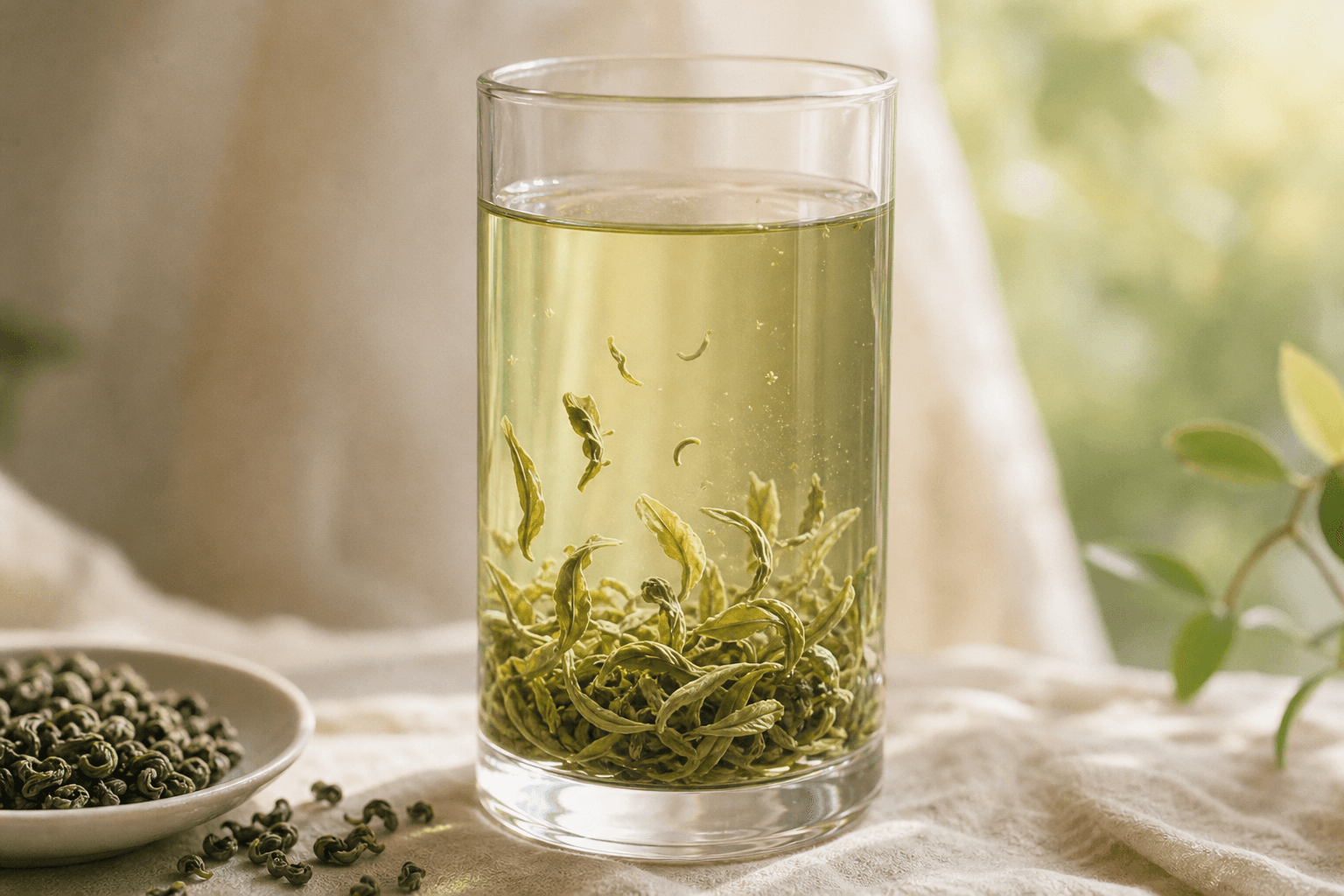
Brew Bi Luo Chun gently. The buds are too tender for a gaiwan rinse and too small for high heat — water at 75–80°C, three grams to a tall clear glass, no preheat that will scald the leaf. The traditional Suzhou method is shang tou: water in first, then a slow scatter of the dry leaf across the surface. The down floats for a moment before the buds sink and begin to spiral open at the bottom of the glass.
The liquor pours pale green-gold, almost luminous against the leaves on the bottom. Across three or four infusions it brightens before it fades — the second cup is usually the most complete, the orchard fragrance and the bud sweetness in balance. By the fourth, the cup is water-clear and quietly grassy, the down dissolved into a soft suspension that gives the body its signature velvet weight.
Velvet body, almost soup-like from the dissolved down. Sweetness arrives early — sugarcane and white grape — under a clean vegetal core that reads as fresh pea shoot rather than herbaceous green tea bite.
Cool and clean, with a returning floral lift that lingers on the breath. No astringency, no metallic edge — only a faint sweetness that brings the orchard back ten seconds after the cup is set down.
Across the session
Buds spiraling open, the down still suspended — fragrance forward, body just beginning to build.
The complete cup. Stone-fruit nose, sugarcane sweetness, velvet weight from the dissolved hair.
Floral retreats, the chestnut and pea-shoot core takes the lead. Body still full but quieter.
Pale and grassy, the buds fully open at the base. A gentle goodbye rather than a fade.