Mineral · Roasted · Complex
The "Big Red Robe" — a legendary Wuyi rock oolong roasted over longan charcoal. Mineral backbone with layers of dark chocolate, toasted grain, and a lingering orchid sweetness.
Brewing Guide
In Traditional Chinese Medicine, fully oxidized and well-roasted oolongs like Da Hong Pao are read as warming and centring — said to harmonise the middle burner, dissolve food stagnation, and quiet a restless qi. The roast itself is part of the framing: charcoal-finished tea is considered "drier" than green or unroasted leaf, better suited to damp climates and cold mornings. In Fujian and Guangdong it is the cup poured after a long banquet, not a polite digestif but a working one.
Modern phytochemistry has begun to catch up with the old framing. Wuyi rock oolongs sit between green and black tea on the oxidation curve, which means they retain a meaningful share of catechins while also developing the theaflavins and theabrownins of fuller fermentation. The slow charcoal roast appears to encourage the formation of polymerised polyphenols specific to roasted oolongs, and the leaf is unusually rich in minerals drawn from the weathered sandstone soils. None of this is a medical claim — but it does explain why the cup feels the way it does: warm, grounded, present rather than wired.
Tradition
Wuyi roasted oolongs are considered "clarifying" — drunk by scholars and abbots through long study sessions for a steady, present alertness without agitation.
Modern lens
Caffeine paired with substantial L-theanine; the roast appears to soften the catechin curve, producing a smoother, more sustained lift than green tea.
Tradition
The classic after-meal cup in Fujian and Chaozhou — said to cut through oily food, dissolve stagnation, and warm a slow stomach back into rhythm.
Modern lens
Roasted oolong polyphenols are studied for their support of pancreatic lipase activity and the microbial ecology of the lower intestine.
Tradition
Long drunk in the cliff villages as a daily tonic — a leaf that "draws strength from the rock" and quietly preserves vitality across the years.
Modern lens
Sits between green and black tea on the oxidation curve, retaining catechins while developing theaflavins; the charcoal roast adds polymerised polyphenols specific to yan cha.
Tradition
Considered a warming circulatory tonic — the roasted oolong of choice for cold mornings and for the heaviness that follows a banquet.
Modern lens
Multiple studies link regular oolong consumption with improvements in LDL cholesterol, triglyceride profiles, and endothelial function.
The Tea
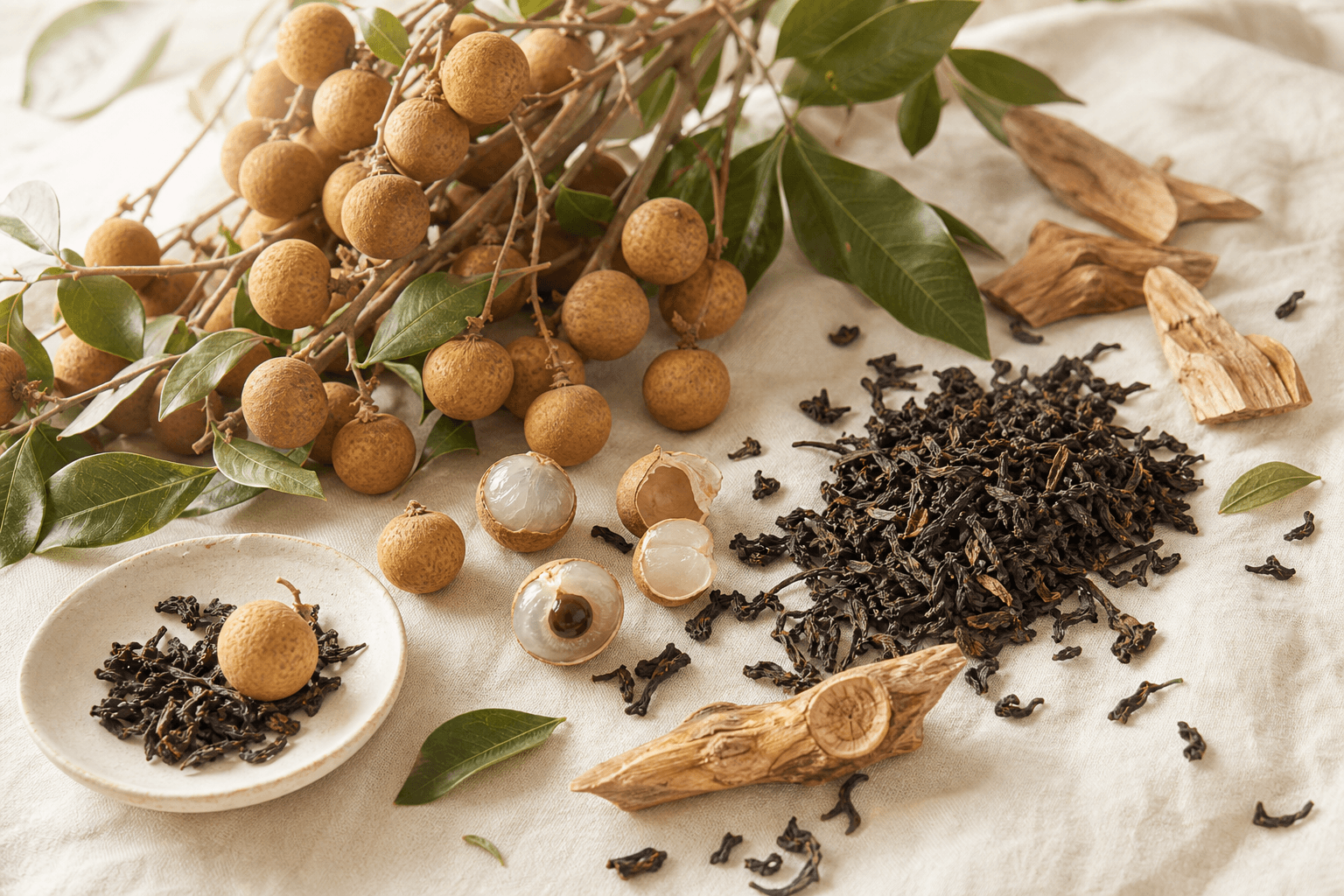
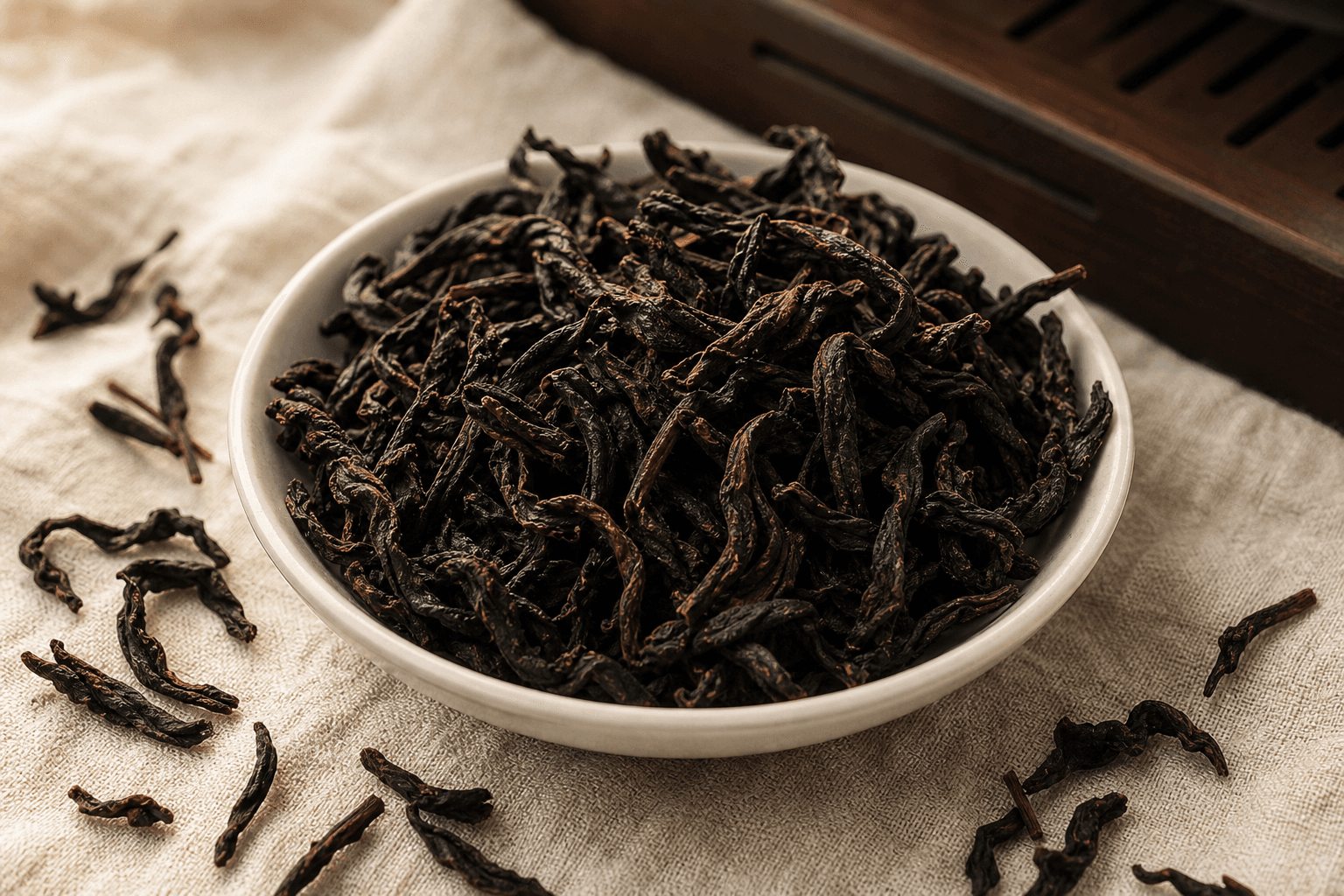
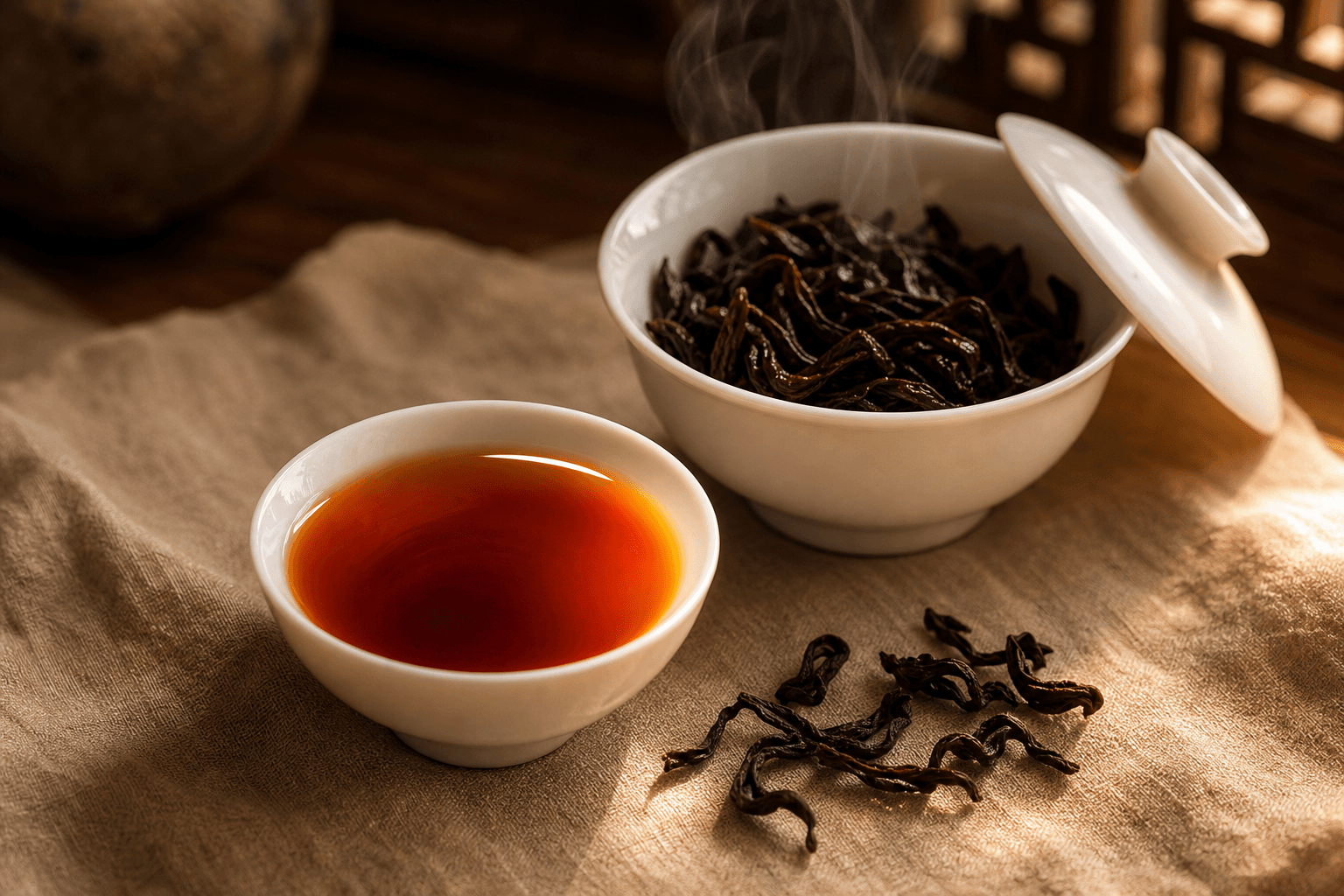
Da Hong Pao is the most celebrated of the Wuyi rock oolongs — yan cha, "cliff tea" — a heavily oxidized leaf finished over longan-wood charcoal until it turns the color of dried tobacco shot through with rust. The leaves are long, twisted, and almost black; pick one up and it feels denser than its size suggests, the way roasted things often do. Brewed, the liquor pours a deep clear amber-mahogany that holds light at the edge of the cup.
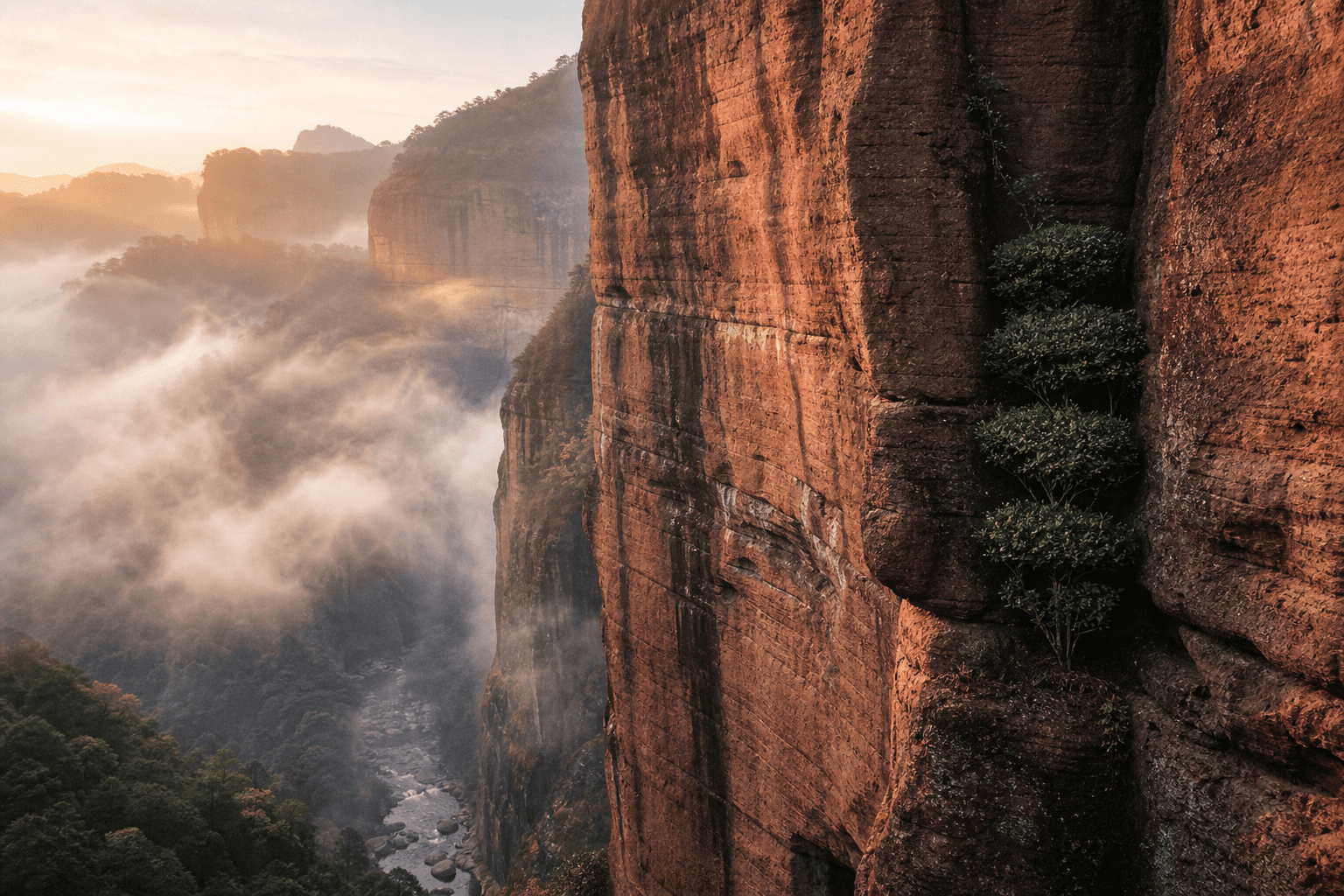
What the leaf really carries is place. The Wuyi range in northern Fujian is a maze of vertical sandstone cliffs and narrow ravines, and the bushes that yield true Da Hong Pao grow in pockets of mineral-rich soil wedged between those rock walls. The roast is the second half of the signature — a slow charcoal finish, sometimes done in three passes over several months, that drives off any green edge and lets the stone come through. It is a tea that refuses to be hurried into a cup.
History & Origins
The legend, repeated in every Wuyi teahouse, is at least partly true. In the Ming dynasty a scholar travelling to the imperial examinations fell ill at the foot of the Wuyi cliffs and was revived by tea picked from a small cluster of bushes growing out of a fissure on Jiulongke — Nine Dragons Nest. He passed the exams. In gratitude, the emperor ordered his own scarlet ceremonial robes carried back and draped across the bushes, and the tea took its name from that moment: Da Hong Pao, "Big Red Robe". Six of those original mother trees still stand on the cliff face today, and Chinese state authorities have not permitted them to be picked since 2006.
The terroir behind the legend is more particular than the story makes it sound. Wuyi tea makers sort their gardens into three tiers — zheng yan, "true rock", grown in the narrow ravines between the central cliffs; ban yan, "half rock", grown on the foothills; and zhou cha, the river-flat tea outside the protected zone. Only zheng yan leaf carries what drinkers call yan yun — "rock rhyme" — the wet-stone minerality and lingering throat-feel that defines the style. The cliff walls hold heat, the mist holds moisture, and the tea bushes root directly into weathered sandstone. Nothing else in China tastes quite like it.
Because the original mother bushes can no longer be harvested, every Da Hong Pao on the market today is a clone — Beidou and Qidan are the two recognised cultivars taken from cuttings of the original trees in the mid-twentieth century — or a Wuyi-style blend assembled to honour the original profile. The longan-wood charcoal roast, chai shao, is the unifying signature: a slow, patient heat that the makers monitor by hand for weeks. That labour, plus the small protected acreage of the zheng yan zone, is why a tin of good Da Hong Pao costs what it does.
Flavor
Brew at 95°C — this leaf wants heat to release the roast. Five grams to a 100ml gaiwan, a fast fifteen-second rinse to wake the charcoal off the leaf, then a true twenty-second first steep. Add roughly five seconds to each subsequent infusion. The liquor pours a clear deep amber that darkens to mahogany by the third cup; held to a window, the rim glows the colour of polished cherry-wood.
The arc is unhurried. Early steeps lead with the roast — toasted grain, dark chocolate, a faint cinder warmth on the back of the palate — over a mineral base that reads like wet river-stone. By the fourth or fifth infusion the charcoal recedes and an unmistakable orchid sweetness surfaces in the empty cup. Late steeps trade complexity for depth: a long, mineral, almost-saline finish and the slow build of hui gan along the throat. Eight to twelve infusions is normal for a good cake of zheng yan leaf; pushed gently, more.
Full and round on the tongue, no astringency where the roast was patient. Mineral undertow carries layers of bittersweet chocolate, toasted barley, and a quiet warm-spice lift mid-cup.
Long, cooling, almost saline. The roast fades and a soft orchid sweetness returns at the back of the throat — hui gan that builds steep over steep and lingers well past the empty cup.
Across the session
The roast leads — toasted grain and dark chocolate over wet stone, the leaf still tightly furled.
Charcoal recedes; the mineral spine of the cliffs steps forward and orchid begins to rise in the empty cup.
Orchid and warm spice in balance with the mineral base — the cups most drinkers remember.
Soft, sweet, almost saline — yan yun lingering on the breath after the leaves have given up their last.