Floral · Smooth · Bright
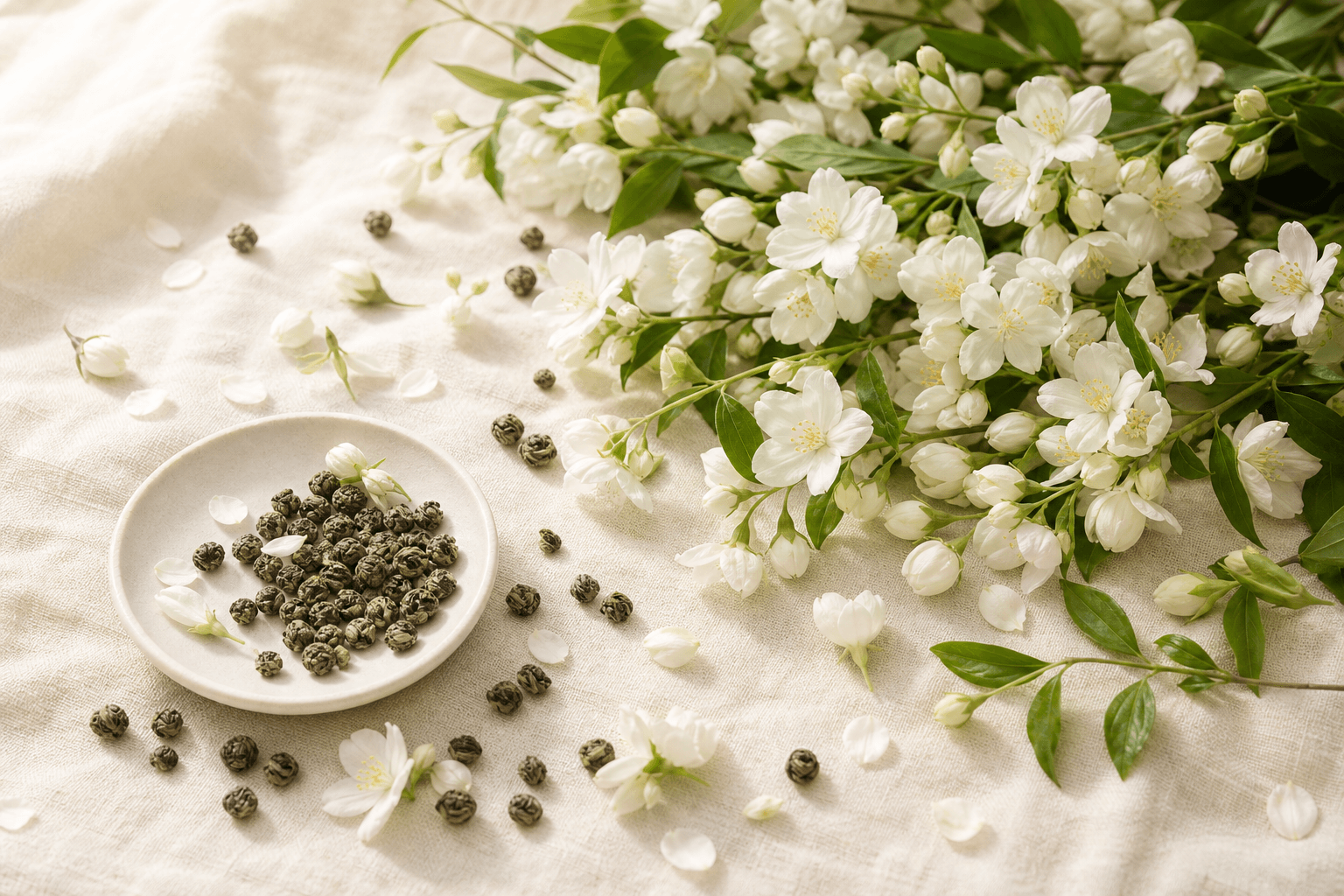
Spring green tea hand-rolled into pearls and scented over multiple nights with fresh jasmine blossoms. The pearls unfurl slowly in the cup, releasing wave after wave of clean jasmine perfume.
Brewing Guide
In Traditional Chinese Medicine, jasmine is classified as warming and qi-moving — drunk to lift a heavy mood, ease tension across the chest, and calm the spirit. Paired with green tea, which is cooling and clarifying, the combination is considered balanced enough for daily drinking: cooling to the head, warming to the heart. It is the cup associated with summer afternoons and quiet conversation.
Modern phytochemistry agrees on the broad strokes. Green tea carries a high load of catechins — EGCG chief among them — alongside L-theanine, the amino acid behind green tea's steady, alert calm. Jasmine adds linalool and benzyl acetate, aromatics studied for their effect on the parasympathetic nervous system through inhalation alone. None of this is a medical claim — but the cup's reputation for gentle focus has a clear chemical foundation.
Tradition
Jasmine is said to lift the spirit and ease tension across the chest — the classic afternoon cup for unhurried thought.
Modern lens
L-theanine pairs with the modest caffeine load to produce alert relaxation; jasmine's linalool is studied for parasympathetic effects.
Tradition
Spring green tea has been drunk in Fujian for centuries as a daily clarifier — light enough to take morning to evening.
Modern lens
Rich in catechins, especially EGCG, which is among the most studied polyphenols for cellular antioxidant activity.
Tradition
Jasmine flowers are traditionally used to disperse stuck liver qi — the framework Chinese medicine uses for low or heavy mood.
Modern lens
Inhaled jasmine aromatics — linalool and benzyl acetate — have been studied for associations with reduced subjective stress.
Tradition
A light green tea after meals is said to clear grease from the palate and ease the stomach without cooling it too sharply.
Modern lens
Green-tea polyphenols are associated with healthy lipid handling and steady metabolism in regular drinkers.
The Tea
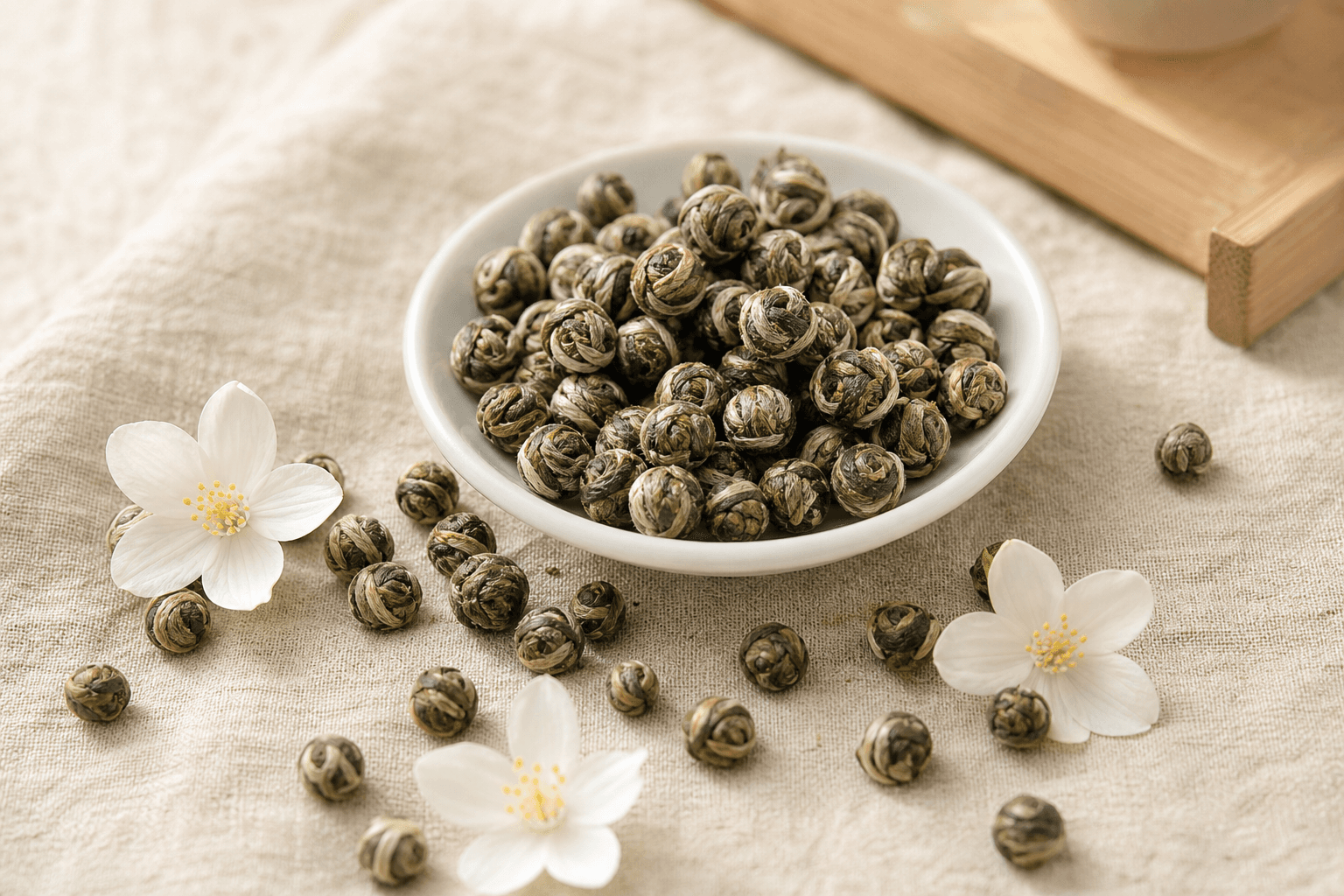
Mo Li Long Zhu — Jasmine Dragon Pearls — begins as spring-picked green tea from Fujian, plucked young while the buds still wear their silver down. Each pearl is hand-rolled around one or two unopened buds and a few attendant leaves, tightened into a sphere no larger than a pea. The rolling is the first quiet feat: too loose and the pearl loosens in the tin, too tight and it refuses to open in the cup.
What sets the tea apart is what happens next. Over six consecutive summer nights, the dry pearls are layered with freshly picked jasmine blossoms collected at dusk. The flowers open after dark and surrender their oils into the leaf overnight; spent blooms are sifted out at dawn and the whole ceremony repeats with a new harvest. By the end of the week the pearls carry the scent of an entire season of flowers without a single petal left in the tin.
History & Origins
Jasmine scenting traces back to the Song dynasty, when imperial perfumers first paired tea with aromatic flowers, but the practice took its modern shape in Fujian during the Ming and Qing — Fuzhou in particular became the centre of jasmine tea production by the eighteenth century, supplying the northern courts and, eventually, much of the export trade. The green-tea base in those early days was a simple loose leaf; the pearled form is a later refinement, prized for keeping the leaf compact so the flower oils have a firm surface to settle into.
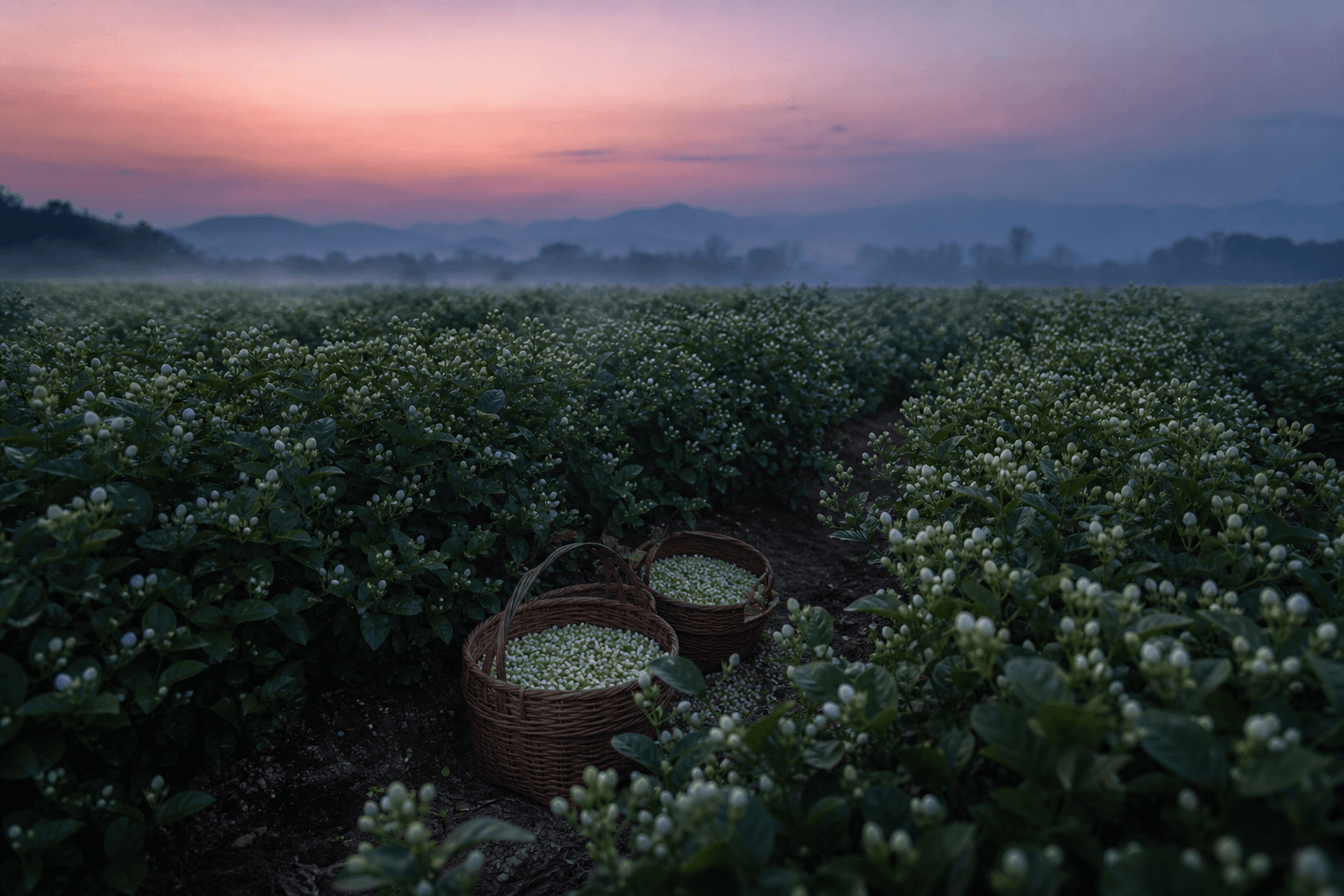
The jasmine itself comes from the warm river plains around Fuzhou and Hengxian, where summer heat coaxes the bushes into nightly bloom. Pickers move through the fields in the late afternoon to gather buds that are swollen but still closed; the flowers must open in the company of the tea, not before. Each kilogram of finished pearls passes through several kilograms of fresh jasmine over the course of the scenting week.
The hand-rolled sphere is a craft tradition that has thinned in the age of machinery — most jasmine tea on the market today is loose-leaf, scented once or twice. True multi-night dragon pearls survive in a handful of small Fujian workshops because the form rewards the work: the tighter the roll, the slower the unfurling, and the longer the perfume lasts in the cup.
Flavor
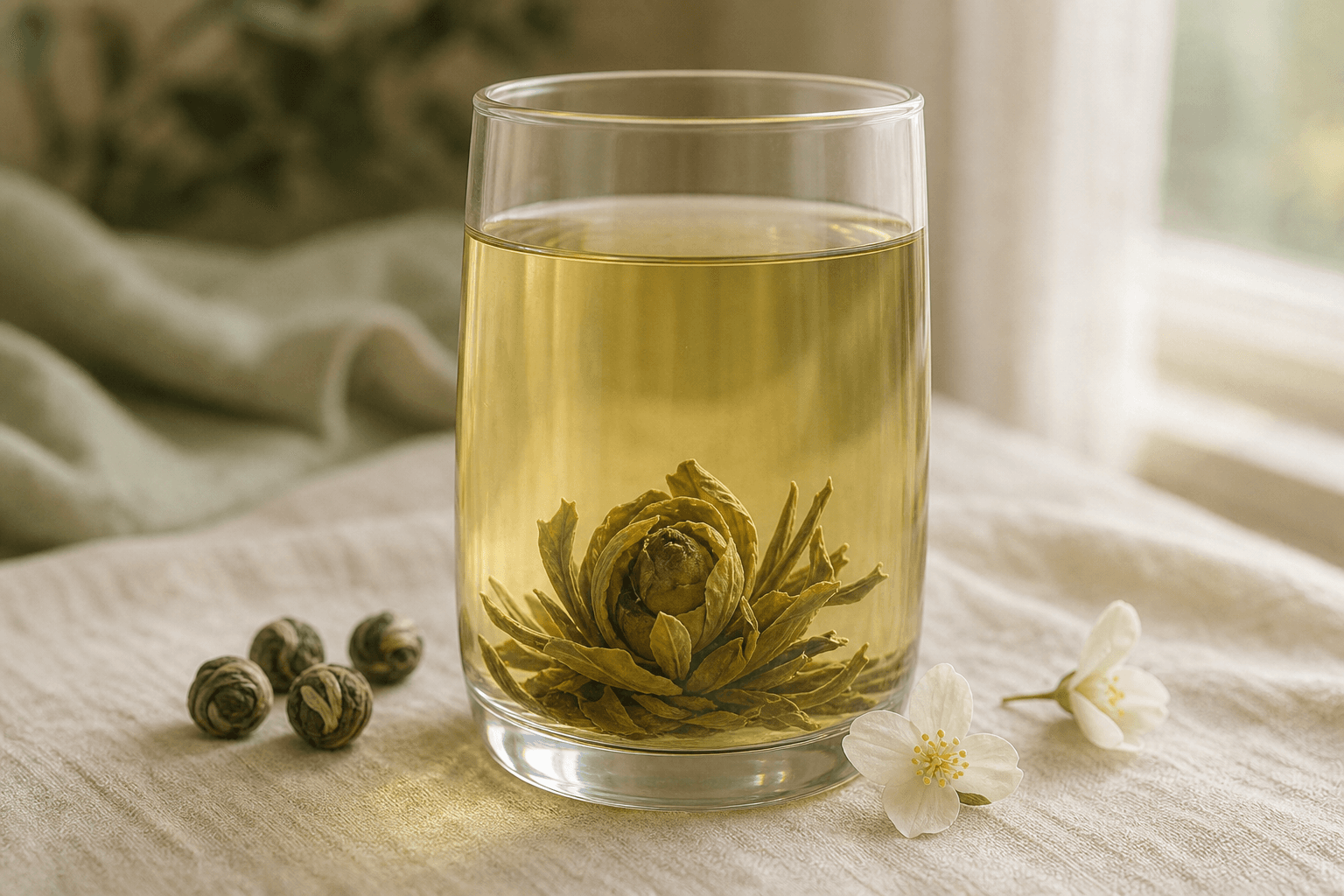
Brew at 85°C — never boiling, which scorches both the green leaf and the volatile florals. Drop four or five pearls into a tall glass tumbler or a glass teapot and watch the first quiet act of the session: the pearls sink, then slowly loosen, releasing their leaves into a soft green spiral. The first infusion runs forty-five seconds; the liquor pours pale gold with a faint green cast.
Across four to six steeps the cup arcs from perfume to leaf. Early infusions are jasmine-forward — bright, nectar-clean, almost honeyed. As the pearls finish unfurling the green tea steps forward: a soft snap-pea sweetness, a chestnut warmth in the back of the cup, the jasmine receding into a quieter floral hum. Brew it Western and the same shape appears, only blurred — one long fragrant cup instead of a procession.
Light-bodied and silky, with a gentle floral honey across the middle and the soft chestnut warmth of well-rolled Fujian green underneath.
Cool and lingering. The jasmine returns on the breath after each sip, a quiet perfume that outlasts the cup itself.
Across the session
The pearls loosen — jasmine forward, the leaf still tightening its grip on the cup.
Full perfume meets first green sweetness; the most complete cups of the session.
Jasmine softens into a hum; chestnut and snap-pea notes from the Fujian base step forward.
Pale, sweet, water-clean — the leaves giving up the last of their florals.