Honey · Cocoa · Longan
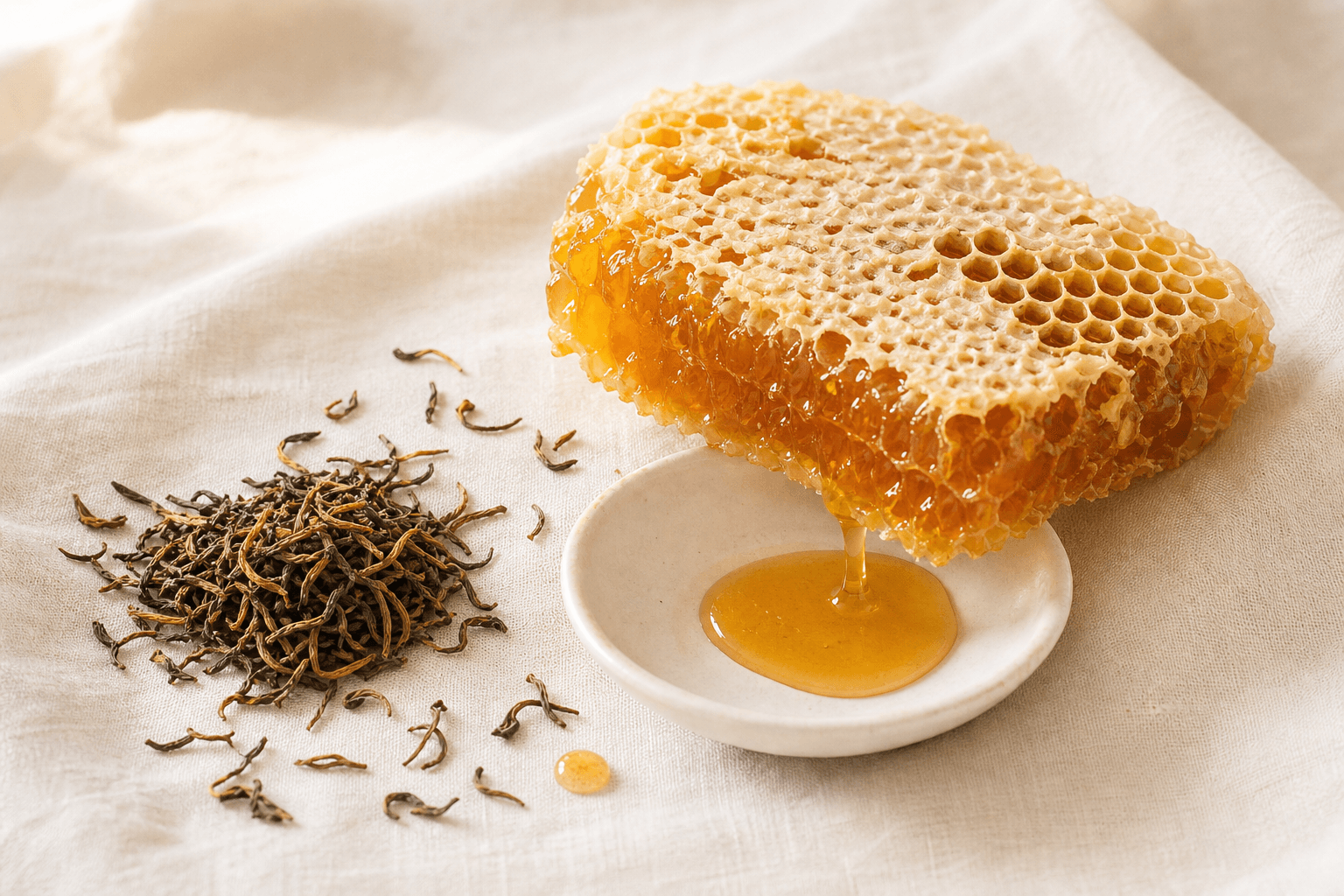
All-bud spring harvest from the same Tongmu Pass that birthed Lapsang Souchong — but unsmoked. Golden tips brew a deep amber liquor with notes of wild honey, dark chocolate, and dried longan. The benchmark Chinese black.
Brewing Guide
In Traditional Chinese Medicine, fully oxidized black tea — hong cha — is read as warming and gently moving. It is the cup poured for a cold start to the day, for clearing damp out of the chest, and for nudging a sluggish digestion back into rhythm. Tongmu makers will tell you Jin Jun Mei in particular is "softer on the stomach" than green or raw pu-erh, which is the practical reason it has become the breakfast tea of choice in much of southern Fujian.
Modern phytochemistry tracks the same territory from a different angle. Black tea is rich in theaflavins and thearubigins — large polyphenols formed during oxidation — and the all-bud picking standard means an unusually high concentration of L-theanine and natural amino acids relative to the leaf. None of this is a medical claim, but it does explain why the cup wakes you up the way it does: present and warm, rather than sharp.
Tradition
Drunk through Fujian winters as a warming morning cup — said to lift the yang and clear damp from the chest before the day begins.
Modern lens
Caffeine paired with high L-theanine from the all-bud leaf; the lift arrives steady and present rather than jittery.
Tradition
Hong cha is classified as warming to the middle burner — the after-meal cup of choice for heavy or cold foods, and gentler on the stomach than green tea.
Modern lens
Theaflavins and oxidized polyphenols are studied for their support of gut motility and the microbial ecology of the lower intestine.
Tradition
A daily tonic in tea-growing Fujian — long associated with steady circulation and a "warm centre" through the cold months.
Modern lens
Multiple studies link regular black-tea consumption with improvements in LDL cholesterol, blood pressure, and endothelial function.
Tradition
The all-bud leaf is considered the most "harmonious" of the black teas — clarifying without being agitating, suited to long reading and quiet work.
Modern lens
High L-theanine content from the buds smooths the caffeine curve; rich in antioxidants associated with cognitive support.
The Tea
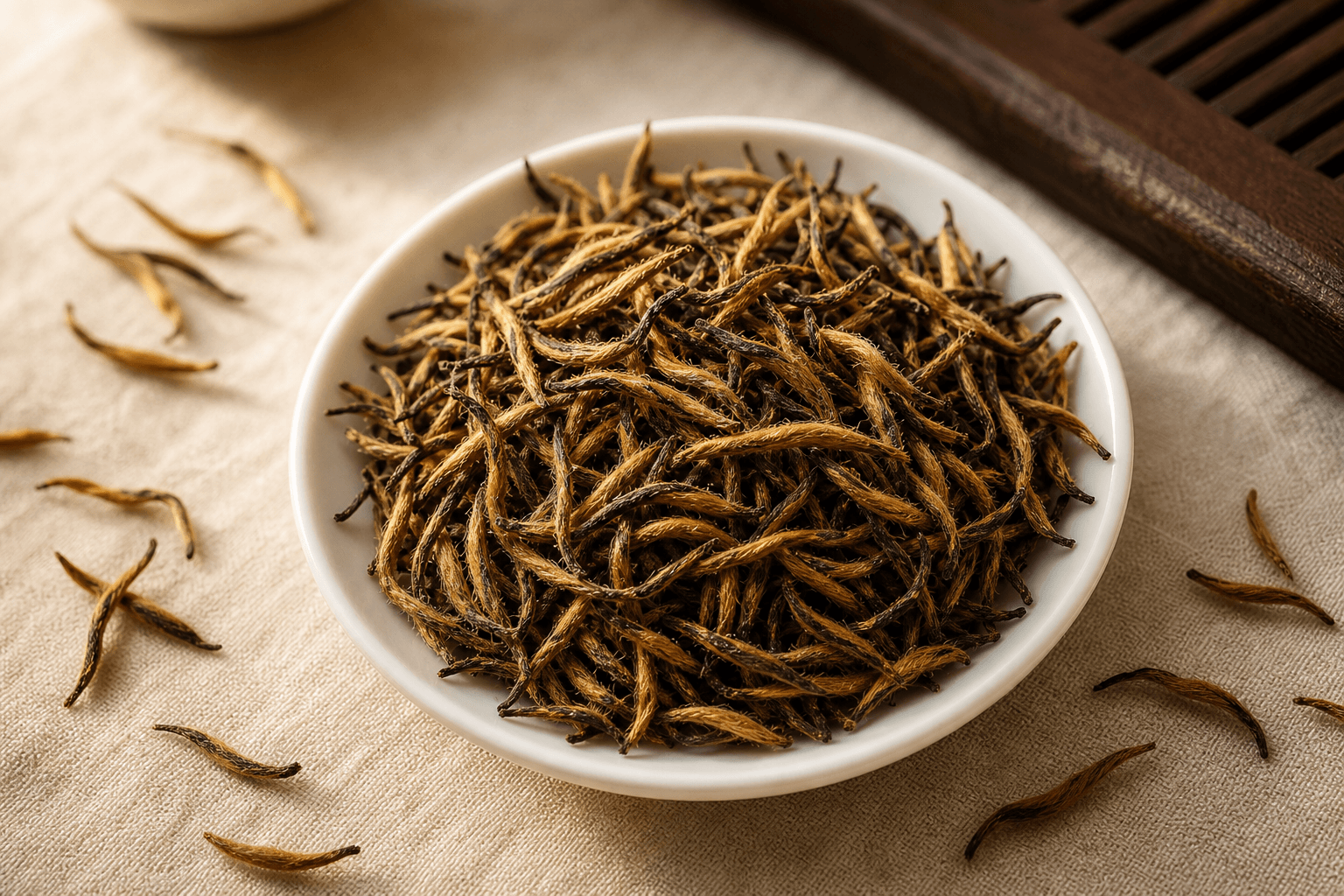
Jin Jun Mei — "Golden Eyebrow" — is the youngest tea on this shelf and arguably the most exacting. The leaf is all bud: tiny, downy, drawn from the same wild Tongmu gardens in the Wuyi Mountains that gave the world Lapsang Souchong, picked at the moment of first opening in early spring. A finished kilo asks for somewhere between fifty and a hundred thousand of these buds, which is most of the reason for the price.
What sets it apart from its smoky cousin is restraint. The leaf is fully oxidized, then finished with gentle warm air rather than pinewood smoke — letting the natural sugars of the bud carry the cup. The final tea reads as a tight, twisted, gold-dusted little needle; brewed, it is the deep amber of dark honey held to the window. Every step from picking to drying is hand-finished by makers who have been working this same valley for generations.
History & Origins
Tongmu is a narrow village strung along a stream in the protected heart of the Wuyi range in northern Fujian — sandstone cliffs, bamboo forest, mist that does not lift before mid-morning. It is also, by most accounts, the birthplace of black tea itself: Lapsang Souchong was made here in the late Ming dynasty, when soldiers passing through forced tea farmers to dry their leaf hurriedly over pinewood fires. The smoke turned out to be a feature.
For four centuries afterwards, Tongmu produced one tea and one tea only. Then, in 2005, a small group of local makers — chief among them Liang Junde and the Jiangyuanxun cooperative — set out to answer a simple question: what would Tongmu leaf taste like if it were processed as a fine black tea, all bud, no smoke? The first batches were experimental, tiny, and almost immediately sold out. The tea was named for the eyebrow-like curl of its finished bud and the gold of its tips.
Jin Jun Mei is therefore unusual in the Chinese canon — a tea with a real founding date and known authors, not a story that drifts back into legend. The Tongmu protected zone now restricts where it can be made, and good Jin Jun Mei still comes only from a few hundred hectares of high-elevation gardens inside the reserve. Demand has long outpaced supply, which is the other half of the price.
Flavor
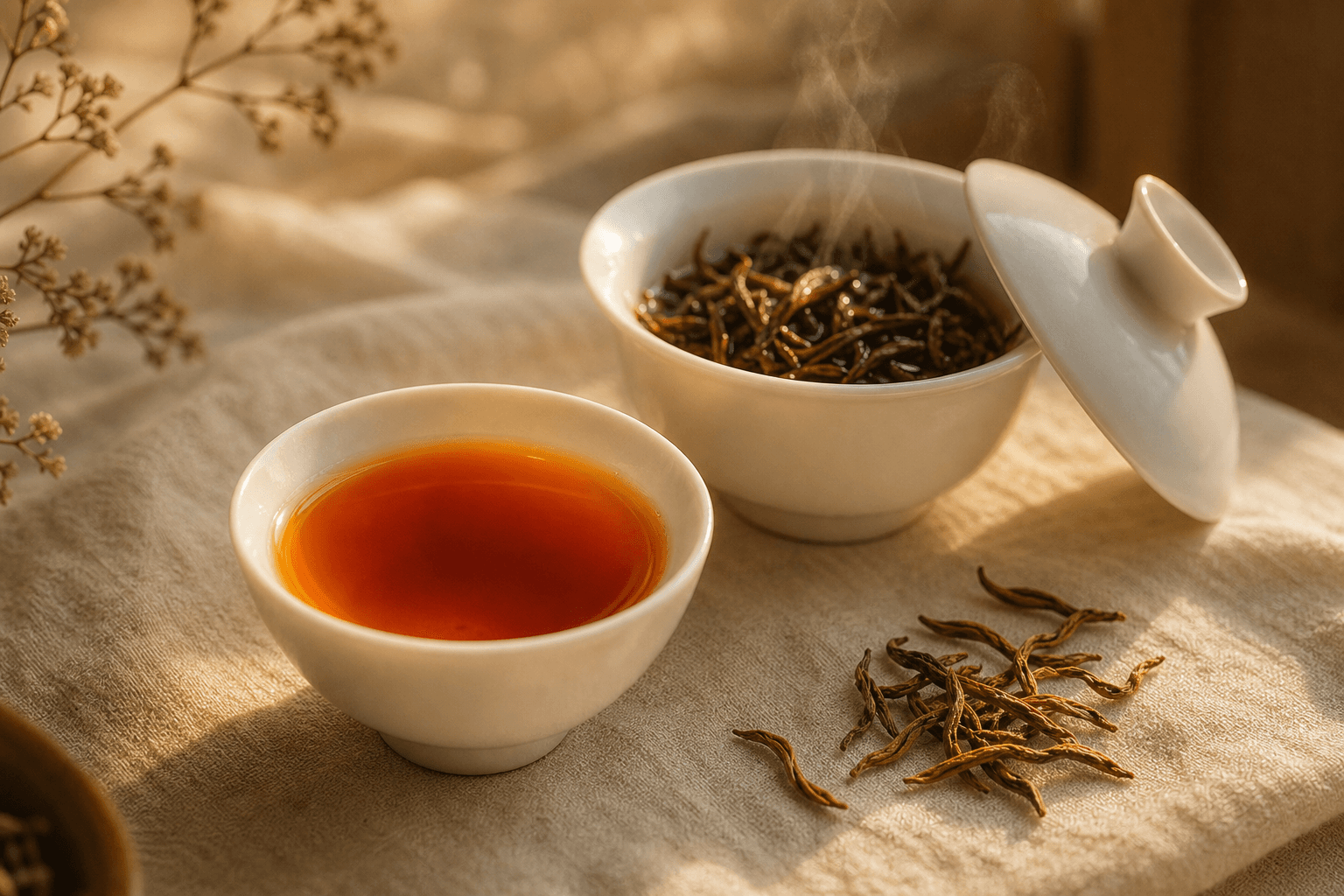
Brew at 90°C — this is a tea that scorches if pushed harder. Four grams of bud to a 100ml gaiwan, a quick rinse to wake the leaf, then a thirty-second first steep. The buds float upright before sinking; the liquor pours a warm clear amber that deepens to mahogany by the third infusion. Add roughly fifteen seconds to each subsequent steep.
The arc is short and sweet — six to eight infusions, not the marathon you would run on a shou pu-erh. Early cups are clean wild honey and fresh-cut sugarcane; the middle cups bring out longan and dark cocoa; the tail steeps fade to malt and warm bread. Brewed Western at 4g per 350ml for two minutes, the same notes simply arrive layered on top of each other in a single fuller cup.
Silky and round, no bite, no astringency. A clear malt-and-honey core carries dried longan in the middle, with a thread of bittersweet cocoa running underneath the sweetness.
Long, warm, almost confectionary — toasted brown sugar and a returning hui gan that coats the back of the throat and lingers well past the empty cup.
Across the session
Bright honey and sugarcane, the buds still unfurling — the most aromatic cups of the session.
Longan and dark cocoa step forward; the body deepens, the liquor pours mahogany.
Malt and toasted bread, a faint sweet-potato note — the cup grows cozier than complex.
Soft, sweet, water-light — honey returning quietly as the leaves give up their last.