Smoky · Pine · Resinous
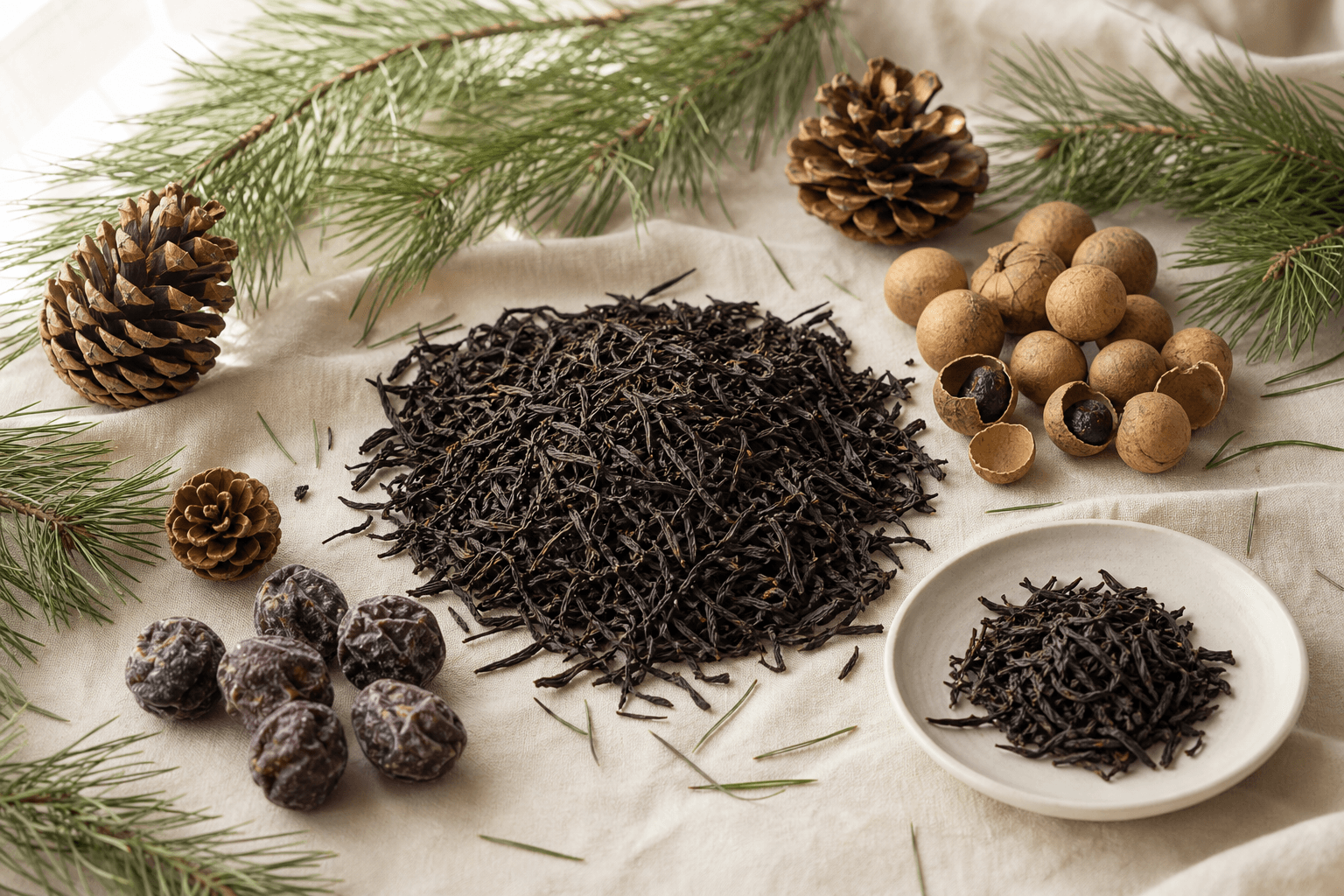
The original smoked tea, dried over burning pine in the bamboo lofts of Tongmu village, Wuyi. Whisky-like resin and campfire smoke up front; sweet stewed-fruit underneath. Polarising — but its devotees are devout.
Brewing Guide
In Traditional Chinese Medicine, fully oxidized black tea — hong cha — is read as warming and gently moving, suited to cold mornings, damp weather, and the heavy end of a meal. Lapsang Souchong, with its added pine character, was historically prized in northern Fujian as a cup for cutting through fatty foods and dispersing chest damp; the smoke itself was said to "open the lungs" and clear the head. It is the tea you pour after a winter dinner of braised meat, or before a long walk in the cold.
Modern phytochemistry sketches a parallel picture. The leaf is rich in theaflavins and thearubigins formed during oxidation, plus a small but distinctive load of pine-derived aromatic compounds picked up in the qing lou. None of this is a medical claim — but it does explain why the cup feels the way it feels: warming, grounding, and present in a way few other teas manage.
Tradition
Drunk through Fujian winters as a warming cup — said to lift the yang, disperse cold, and clear damp from the chest before the day begins.
Modern lens
Caffeine and theaflavins from full oxidation are studied for their effect on circulation and thermogenesis — the cup arrives warm and steady.
Tradition
The classic after-meal cup for braised and fatty foods — said to cut grease and ease a heavy middle burner without chilling the stomach.
Modern lens
Oxidized polyphenols are studied for their support of gut motility and their interaction with dietary lipids during digestion.
Tradition
A daily tonic in tea-growing Fujian — long associated with steady circulation and a warm centre through the cold months.
Modern lens
Multiple studies link regular black-tea consumption with improvements in LDL cholesterol, blood pressure, and endothelial function.
Tradition
The pine character was traditionally said to "open the lungs" and clear the head — the cup poured before a long walk in cold weather.
Modern lens
Caffeine paired with the aromatic terpenes of pine smoke; the lift reads as alert and grounded rather than wired.
The Tea
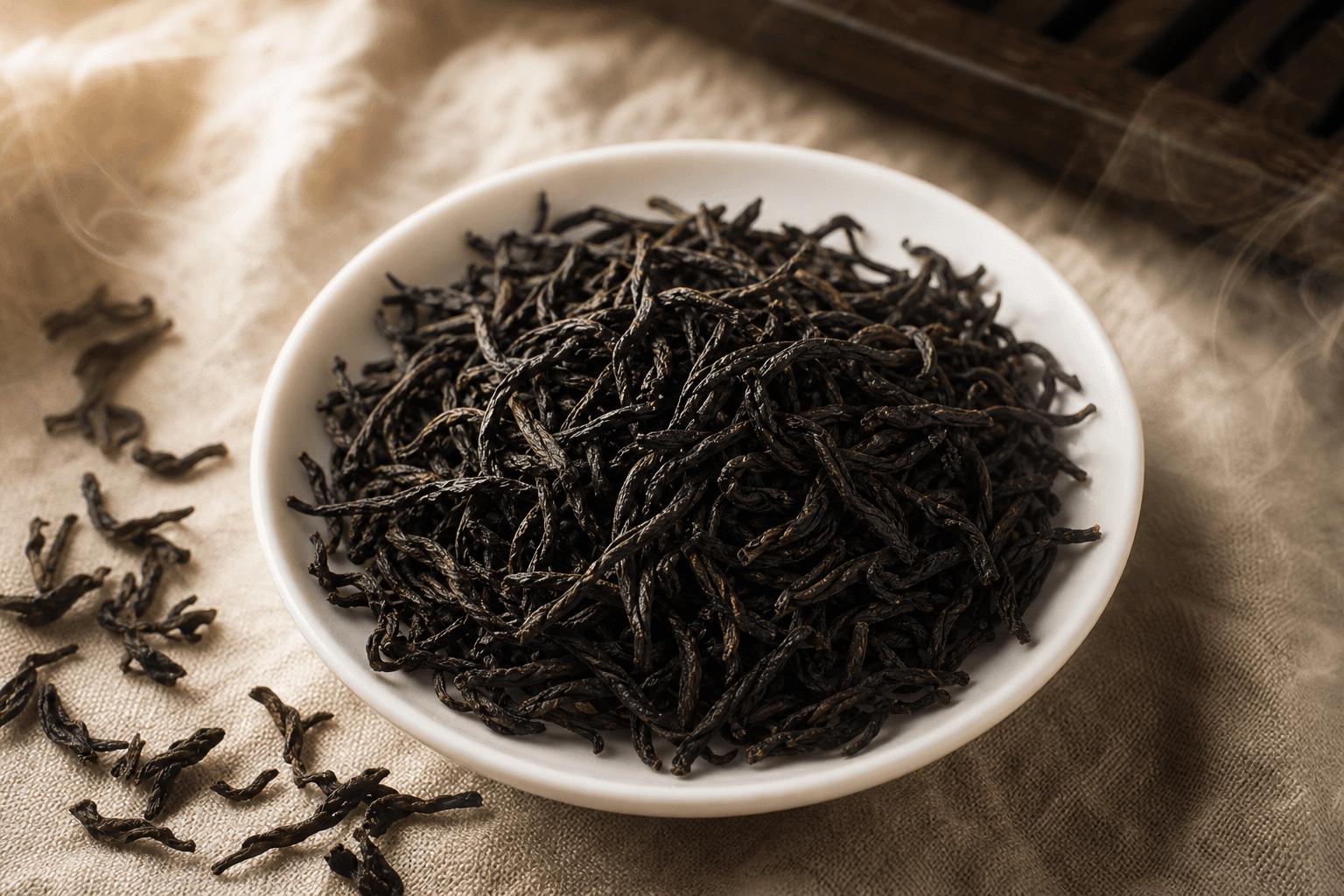
Lapsang Souchong — Zheng Shan Xiao Zhong, the "original mountain small-leaf variety" — is the tea that taught the world what black tea was. The leaf is long, dark, and tightly twisted, drawn from the same Tongmu valley in the Wuyi Mountains where Jin Jun Mei is now made; processed, however, with an entirely opposite philosophy. Where its all-bud cousin retreats from smoke, this one walks straight into it.
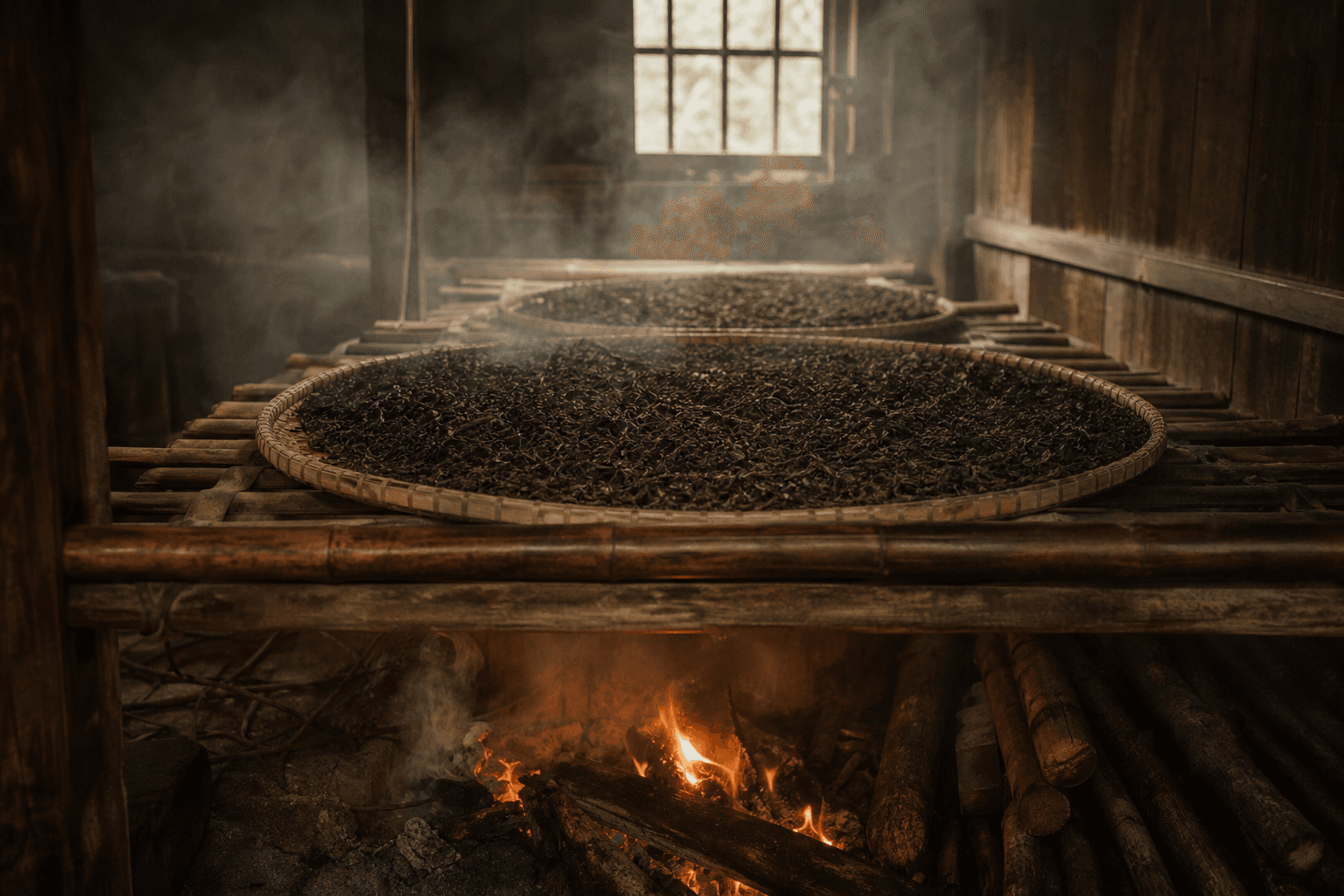
After picking and oxidation, the leaf is dried in a traditional bamboo loft — a qing lou — set above a slow pinewood fire. Resinous Masson pine is burned for hours below, and the smoke filters up through the slatted floor and into the leaf above. The result is a tea that smells, before it is even brewed, of campfire, cedar smoke, and something like single-malt whisky. It is hand-finished by makers whose families have been tending this same fire for four hundred years.
History & Origins
The story of black tea begins, by most accounts, in the late Ming or early Qing dynasty in a small village called Tongmu, set deep in the protected interior of the Wuyi range in northern Fujian. Troops moving through the region during a harvest occupied the village just as the spring leaves were being processed. The work stopped; the leaves sat. By the time the soldiers left, the picked tea had over-oxidized — ruined, by the standards of the green and oolong tradition that prevailed at the time.
Rather than discard the harvest, the villagers improvised. They spread the leaf across bamboo mats in the drying lofts above their houses and lit fires of resinous Masson pine below to drive the moisture out fast. The smoke saved the crop. The tea that came down from the lofts was unlike anything sold before: dark, fully oxidized, deeply scented with pine. It was packed off to the coast almost as an afterthought, and there a Dutch trader bought the lot.
Lapsang reached Europe not long after, and the West first met Chinese tea in this smoky, fully oxidized form — which is why "black tea" became, for a long time, the entire English-language idea of what tea was. The Tongmu valley, now a protected nature reserve, still produces it the same way: bamboo lofts, pinewood fires, four centuries of muscle memory. Jin Jun Mei, invented down the lane in 2005, is the unsmoked descendant of the same leaf — twins from one valley, raised on opposite philosophies.
Flavor
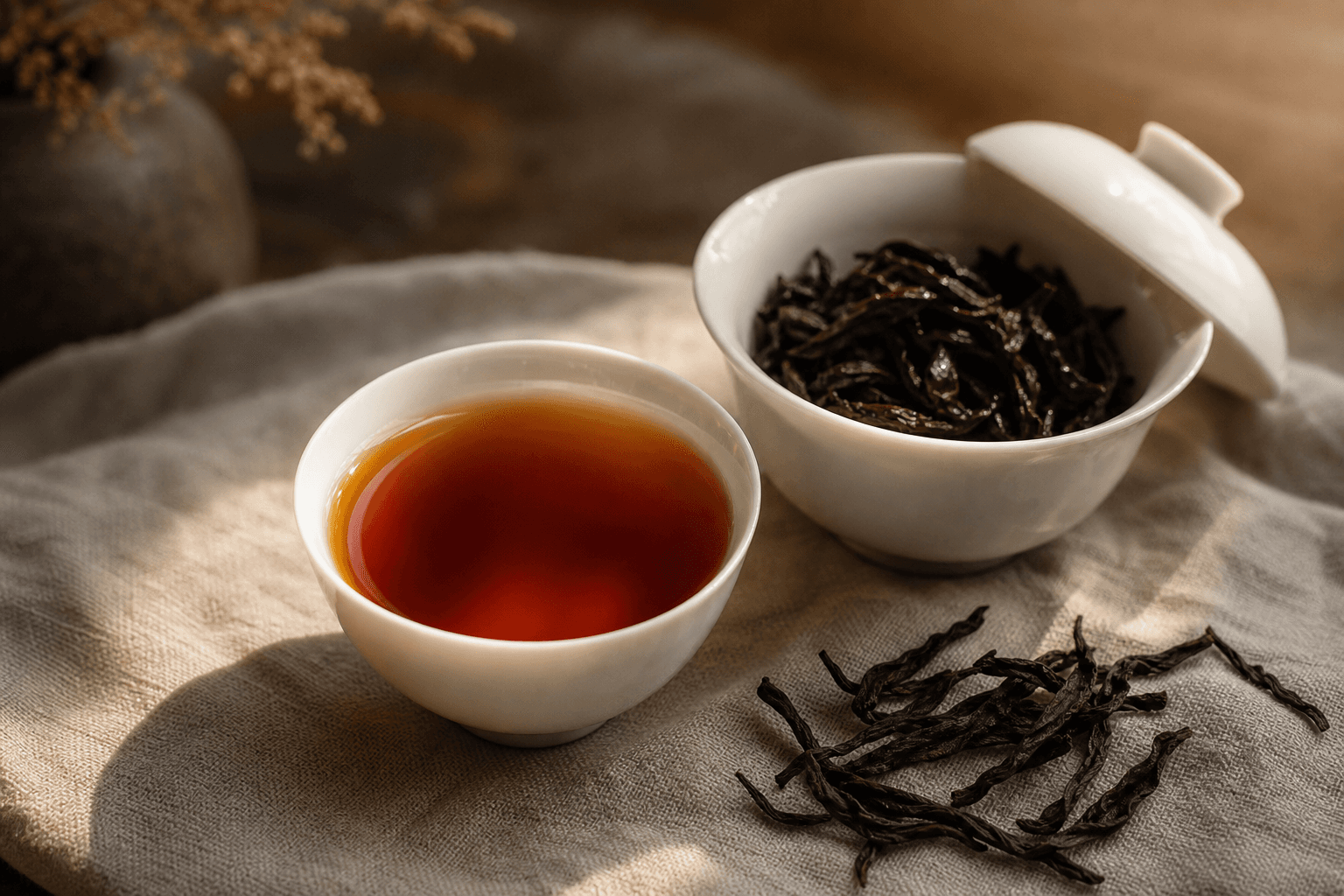
Brew at 95°C — slightly cooler than a fully boiling pour. Five grams of leaf into a 100ml gaiwan, a quick rinse to lift the surface smoke, then a true twenty-second first steep. The liquor pours a deep amber with a mahogany centre; warm light through the cup catches a faint copper edge. The first lift off the rim is unmistakable: pine resin, woodsmoke, a hint of leather.
What surprises new drinkers is the second layer. Beneath the smoke sits a quiet sweetness — stewed longan, dried plum, a touch of malt — that builds steep over steep as the surface smoke recedes. Across six to eight infusions the cup walks down the campfire road and into the orchard. Brewed Western at 4g per 350ml for three minutes, the same notes layer on top of each other; the smoke remains the headline either way.
Round and dry on the body, with the smoke wrapping a clear core of stewed longan and dried plum; a malty sweetness builds underneath as the cup cools.
Long, warm, slightly resinous — the smoke recedes into a clean dried-fruit sweetness that lingers on the breath like a banked fire.
Across the session
Pine smoke at the front, leaf still tight — the most assertive cups of the session.
Smoke softens; stewed longan and dried plum step forward beneath the resin.
Sweetness leads, smoke trails — malt and warm bread emerge in the middle.
Soft, sweet, faintly resinous — the leaves giving up their last quiet wood-smoke notes.