Honey · Orchid · Aromatic
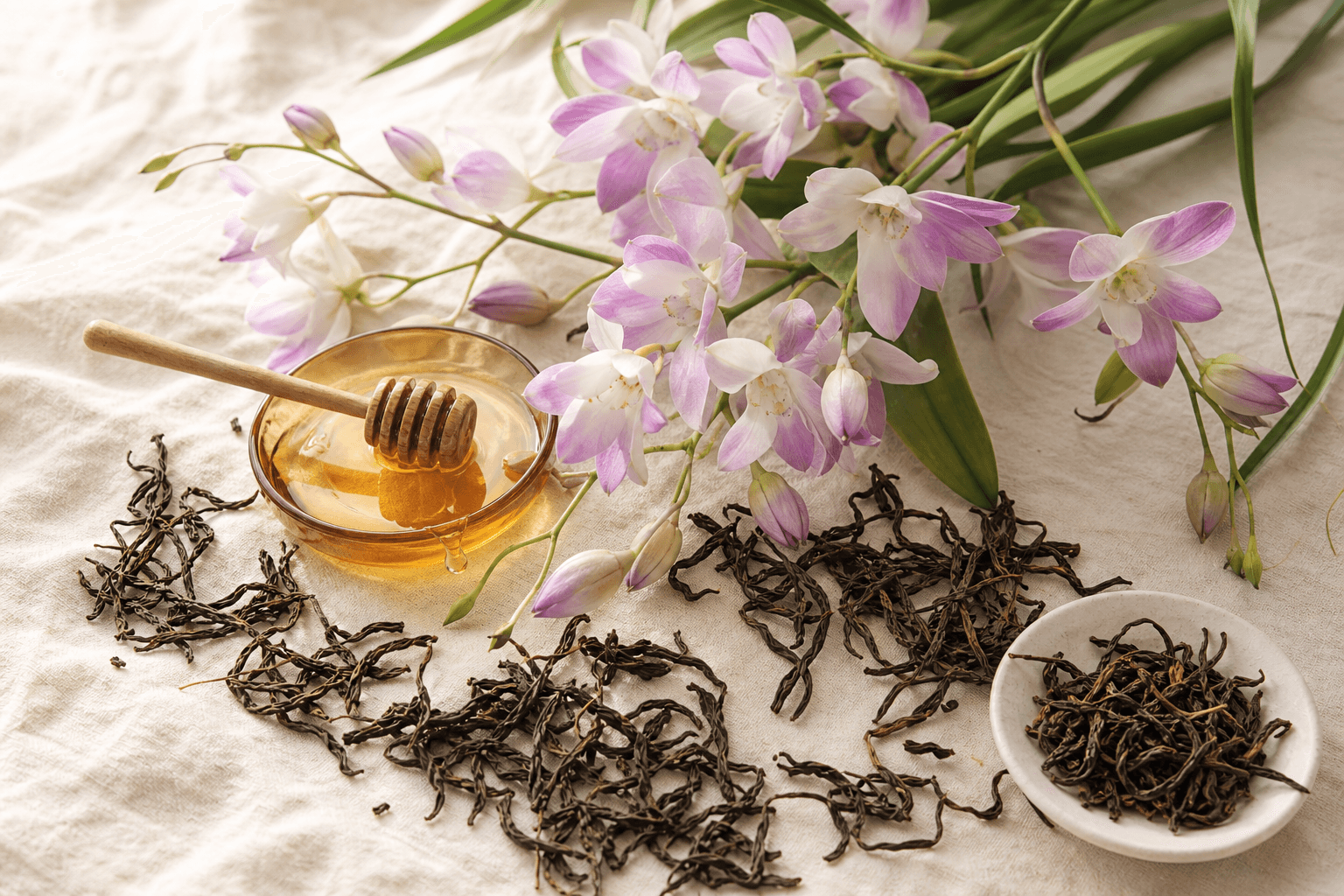
"Honey Orchid Fragrance" — a single-bush Phoenix Dancong from Fenghuang Mountain. Long twisted leaves yield an almost wine-like aromatic profile: tropical orchid, ripe stone fruit, and a honeyed finish that lingers on the breath.
Brewing Guide
In Traditional Chinese Medicine the Phoenix Dancong oolongs are read as warming and qi-moving — neither cooling like green tea nor heating like a fully fired Wuyi yancha, but something carefully in between. The medium oxidation and charcoal roast are said to soothe the spleen and stomach, dispel food stagnation, and lift fatigue without scattering the mind, which is why the cup is poured so freely after the rich seafood meals of Chaozhou.
Modern work on partially-oxidised oolongs identifies the same broad family of compounds that make the cup feel the way it does — methylated catechins, theaflavins, a heavy aromatic load of geraniol, linalool, and methyl jasmonate carried over from the fresh leaf. None of this is a medical claim — but the chemistry quietly explains why a properly brewed Mi Lan Xiang feels alert, settled, and unusually long on the palate.
Tradition
Drunk after rich Chaozhou seafood and braises to disperse food stagnation and warm the middle burner — the after-dinner cup of the region.
Modern lens
Partially-oxidised oolongs are studied for their effect on lipid handling and post-meal blood sugar response.
Tradition
Phoenix oolongs are considered qi-moving without being scattering — the working tea of Chaozhou tea masters across long sessions.
Modern lens
Caffeine paired with L-theanine and aromatic terpenes; associated with steady alertness rather than the spike-and-crash of coffee.
Tradition
Long-roasted leaf was kept through the year as a daily tonic — a cup considered to "clear heat" gently without cooling the body.
Modern lens
Rich in theaflavins, thearubigins, and methylated catechins formed during oxidation and roasting — a different polyphenol profile than green tea.
Tradition
The honey-orchid aroma was prized for "opening the chest" — drunk to ease emotional heaviness as much as physical fatigue.
Modern lens
High in linalool, geraniol, and methyl jasmonate — the same volatile compounds studied for mood and stress-response effects in aromatherapy research.
The Tea
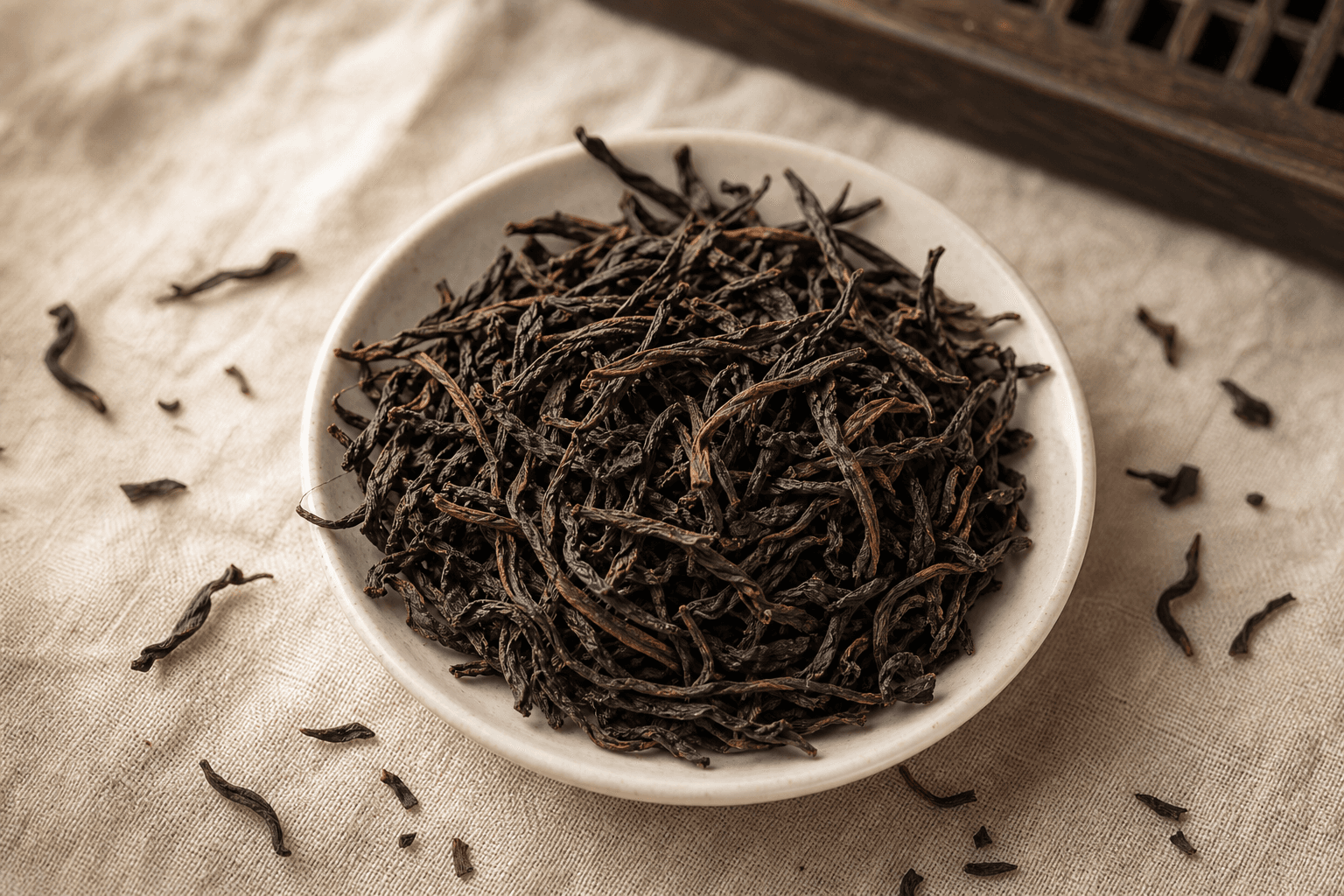
Mi Lan Xiang — "Honey Orchid Fragrance" — is the most celebrated of the Phoenix Dancong oolongs, a tradition built on the Chinese idea of dan cong: a single mother tree, distinctive enough in aroma to be propagated as its own named cultivar. The leaves are long, dark, irregularly twisted ropes — nothing like the rolled-ball oolongs of Anxi or Taiwan — with a faint reddish-brown sheen earned through medium oxidation and a careful charcoal roast.
The aromatic intensity comes from the bush itself, not from any added flower. Phoenix Mountain growers select trees whose fresh leaf already carries a perfume reminiscent of orchid, lychee, or honey, then build the processing around that signature — withering through the night, kneading by hand, finishing over low charcoal until the aroma is set. A well-made Mi Lan Xiang smells of the bush it came from, sharpened.
History & Origins
Fenghuang Shan — Phoenix Mountain — rises sharply out of Chaozhou in eastern Guangdong, a granite massif of narrow ridges and ancient terraced groves. Tea has been worked here since the Southern Song, when, according to local lore, a fleeing emperor was given leaves from a wild bush on Wudong Peak that revived him on the road south. The variety that grew from those bushes became known as Song Zhong — "Song dynasty stock" — and is the genetic ancestor of every Dancong made today.
What sets Phoenix tea apart is the dan cong tradition itself: rather than blending leaf from a whole orchard, growers identify individual mother trees with unusually expressive aromas and propagate each as its own named cultivar. Over centuries the village families catalogued ten classic aroma types — gardenia, magnolia, ginger flower, almond, cinnamon, grapefruit peel, and the most prized of them all, mi lan xiang, honey orchid. A few of the original mother trees still stand on the upper slopes, several centuries old, gnarled and protected.
Mi Lan Xiang itself emerged as a recognised aroma profile in the late Qing, when Chaozhou's gongfu drinking culture pushed Phoenix farmers toward higher oxidation and longer roasts than the green oolongs further south. The cup that resulted — wine-dark, fruit-forward, with a honeyed finish that hangs on the breath — became the calling card of the region and remains the benchmark by which the other Dancong styles are measured.
Flavor
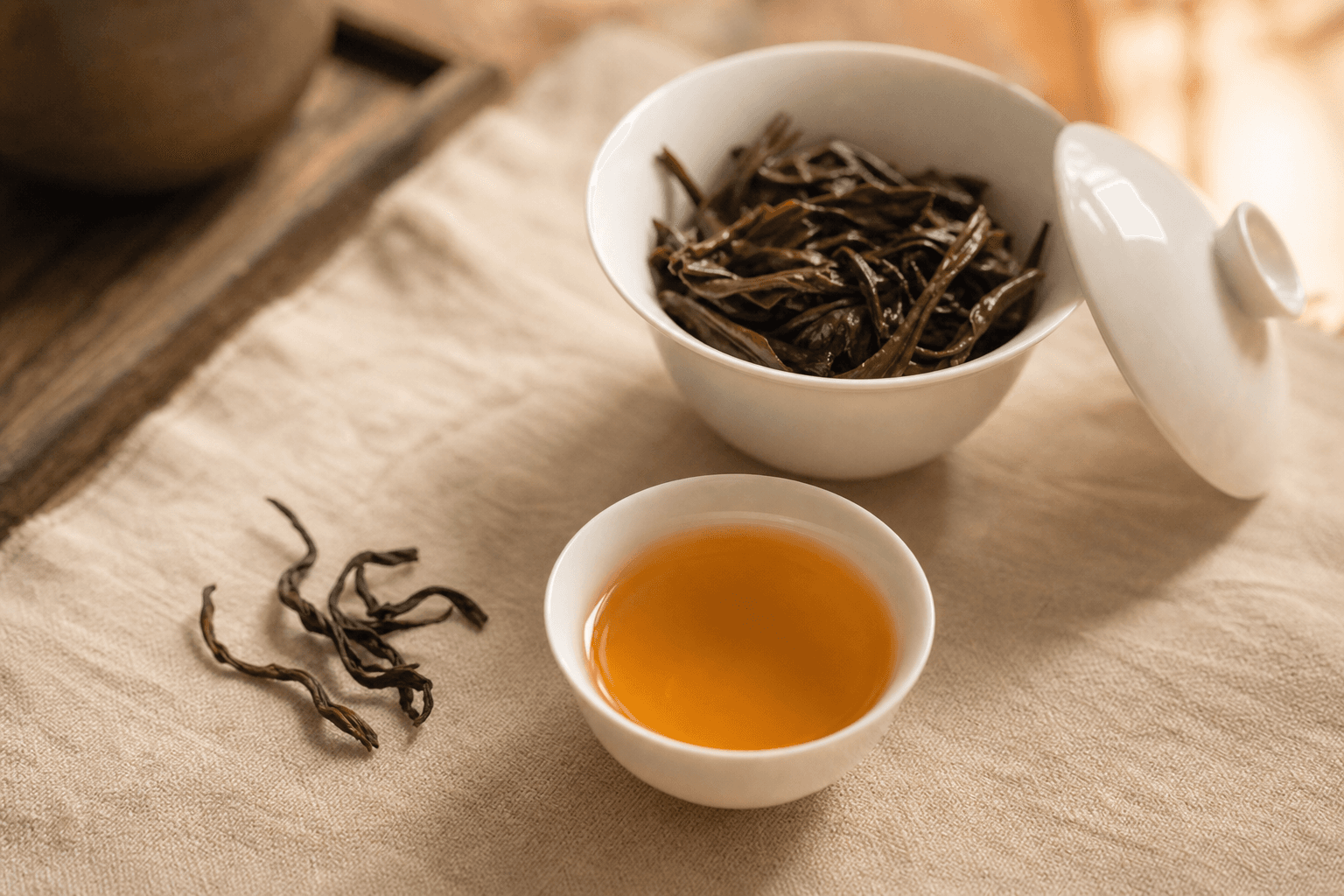
Mi Lan Xiang is a gongfu tea — it rewards small vessels, hot water, and short pours. Use a 100ml gaiwan, five grams of leaf, water at 95°C. Rinse for five seconds to wake the long ropes; the aroma off the wet lid alone is the first reason to drink this tea. First true steep at fifteen seconds: the liquor pours a clear amber-gold with a faint apricot edge, and the empty cup smells unmistakably of tropical orchid and warm honey.
Across the next eight or nine infusions the cup walks a long arc. The early steeps are the loudest — perfumed, almost wine-like — and the middle steeps trade some of that intensity for ripe stone-fruit body: lychee, white peach, a faint apricot pit. By the tail the orchid has receded but the honey lingers, and the famous gan run — the returning sweetness that Chaozhou drinkers prize above all — settles into the back of the throat and refuses to leave.
Round, almost wine-like body. Stone fruit through the middle — peach skin, apricot, a quiet undercurrent of charcoal warmth from the finishing roast.
Long honeyed gan run that builds from steep to steep, the breath tasting faintly of orchid for minutes after the cup is set down.
Across the session
Orchid and honey crash forward — the most aromatic cups of the session.
Stone fruit takes the middle. Lychee and peach round out under the floral.
Charcoal warmth surfaces; the bush's mineral character reads through the sweetness.
Florals fade, but the honeyed finish stays — gan run lingering long after the leaf is spent.