Meadow · Hay · Gentle
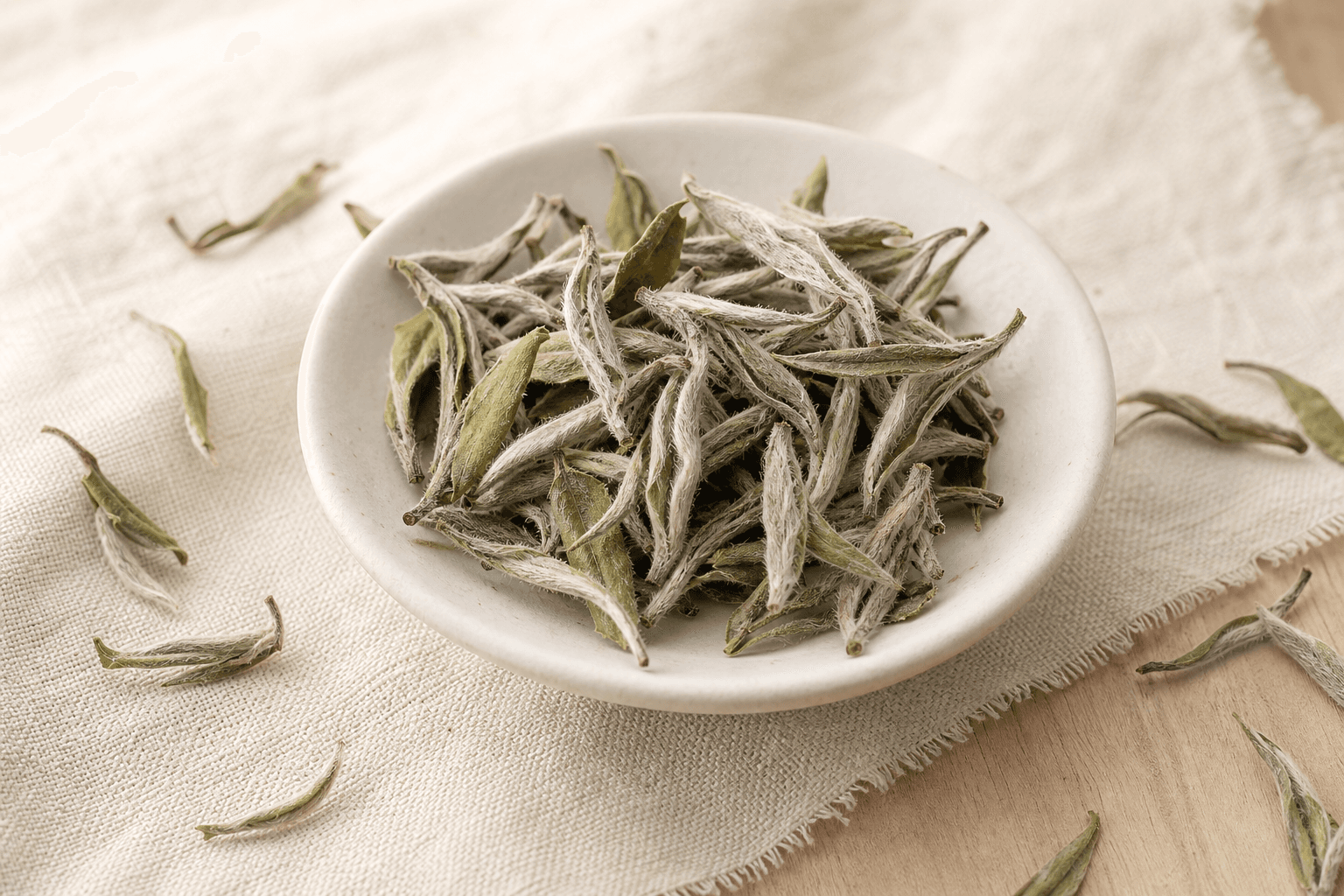
Bai Mudan harvested in early spring — one bud, two leaves. Sun-withered and barely processed, it tastes of hay fields, wildflowers, and the quiet warmth of afternoon light.
Brewing Guide
In Traditional Chinese Medicine, white tea is classified as cooling — the natural counterweight to summer heat and inner restlessness. Fuding households have long kept aged Bai Mu Dan in the cupboard for sore throats, low fevers, and the dry edge of a long indoor winter. It is the tea given to the very young and the very old precisely because it is so unhurried: minimal processing, minimal caffeine punch, minimal demand on the system.
Modern phytochemistry tells a complementary story. Because the leaf is barely processed, Bai Mu Dan retains a high load of catechins, EGCG, and the L-theanine that lends white tea its characteristic calm. The silver bud-fuzz itself is rich in polyphenols. None of this is a medical claim — but it does explain why the cup feels the way it feels: gentle and bright without ever feeling caffeinated.
Tradition
White tea has been kept in Fuding pantries for generations as a daily clearing cup — taken to settle inner heat and refresh the body through long humid summers.
Modern lens
Among the highest catechin and EGCG concentrations of any tea category; minimal processing leaves the leaf's polyphenol load almost fully intact.
Tradition
Drunk through the dry months to brighten complexion and cool the kind of redness Chinese medicine reads as rising heat.
Modern lens
Polyphenols on the silver bud-fuzz are studied for free-radical scavenging; white tea extracts appear in dermatological research on UV-related stress.
Tradition
The classic afternoon cup for slow conversation — light enough not to disturb sleep, settling enough to soften a busy mind.
Modern lens
Notably high in L-theanine relative to its modest caffeine content; the ratio is associated with focused calm rather than stimulant edge.
Tradition
A Fuding household remedy for the first scratch of a sore throat or a dry cough that sets in at the change of season.
Modern lens
White tea is studied for antibacterial and anti-inflammatory activity in upper-respiratory contexts; aged Bai Mu Dan is the form most prized for this.
The Tea
Bai Mu Dan — White Peony — is the everyday white tea of Fuding, picked at the early spring flush from the broad-leaved Da Bai cultivar. The picking standard is "one bud, two leaves": a downy silver tip flanked by two pale young leaves still attached at the stem. That extra leaf is what separates it from the all-bud Bai Hao Yin Zhen and gives the cup its hay-field depth, its wildflower lift, its quiet body.
Processing is the lightest hand in tea. The fresh leaf is laid out on bamboo trays under filtered Fujian sun and left to wither — no pan-firing, no rolling, no shaping. After a slow dry the leaf is barely changed: the bud still wears its silver fuzz, the leaves still curl naturally inward, and the whole sprig keeps the architecture it had on the bush. Nothing is added; almost nothing is taken away.
History & Origins
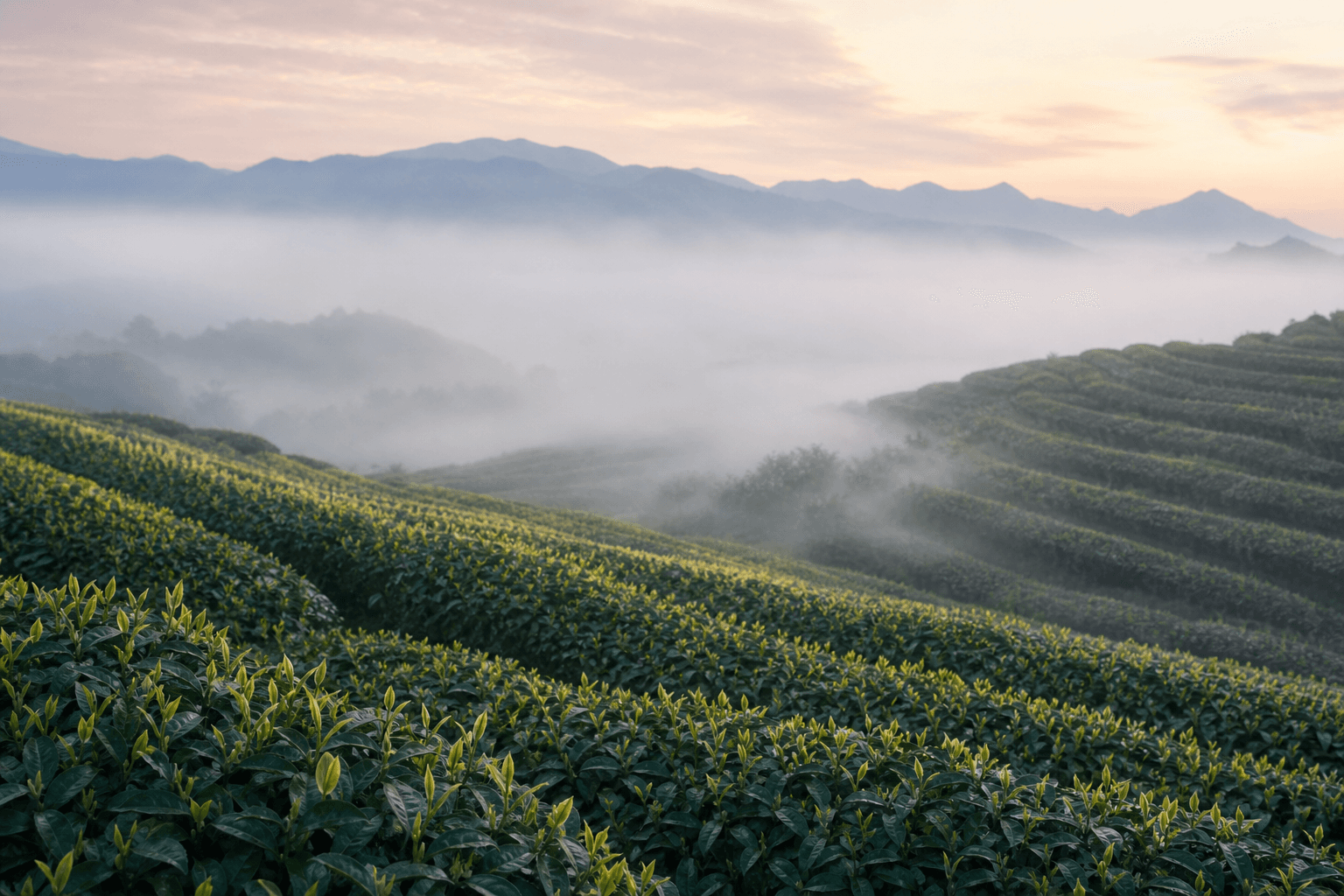
White tea as a distinct category traces to the Fuding hills of northeastern Fujian, where the Da Bai — "Big White" — cultivar was identified in the early nineteenth century around the village of Diantou. Its leaves grow larger than common bushes and carry an unusually heavy bloom of silver hair on the young buds, exactly the trait the white-tea processors needed. Bai Mu Dan itself is the early-twentieth-century invention: a grade pitched between the rare Silver Needle and the everyday Shou Mei, made to put white tea on more tables.
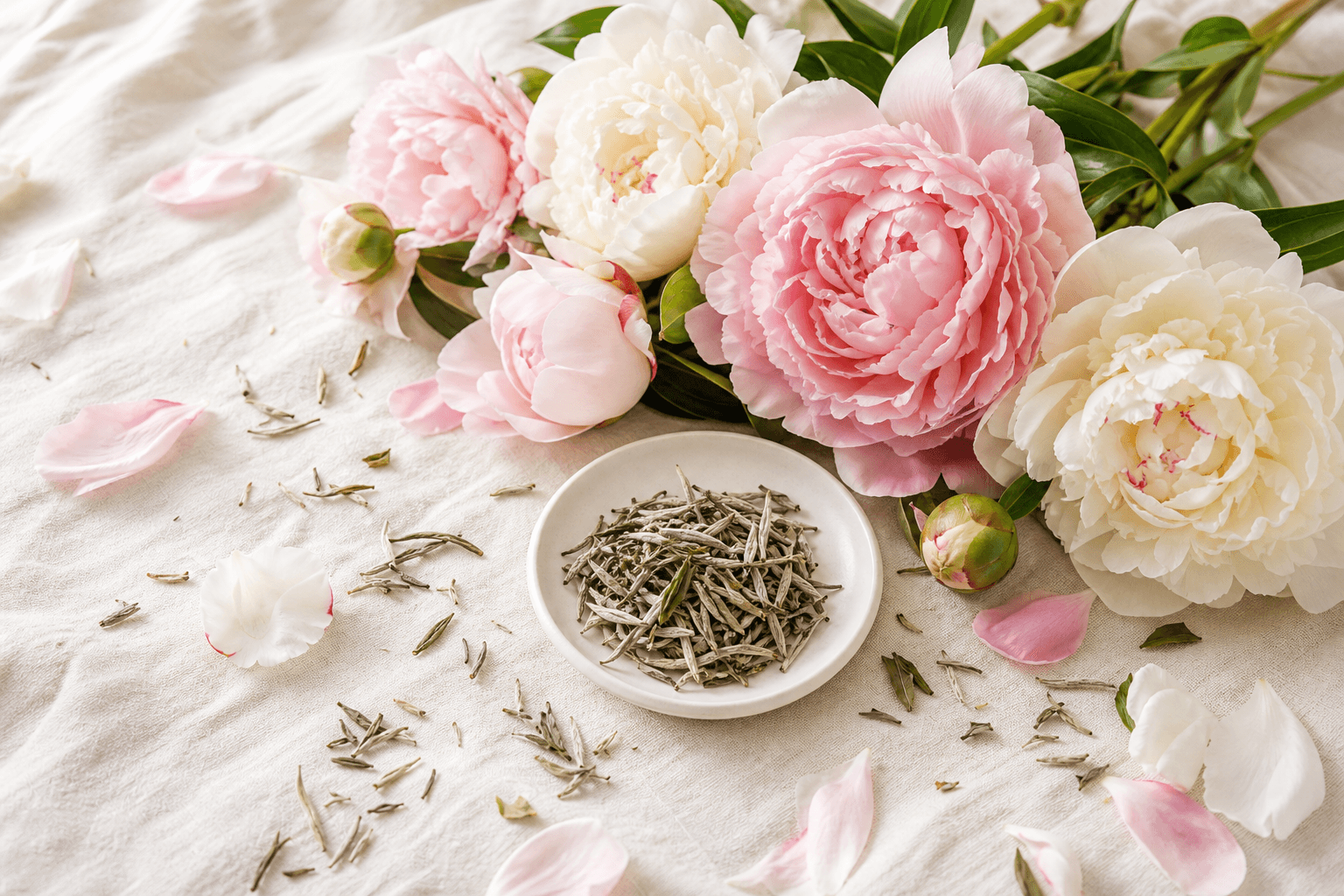
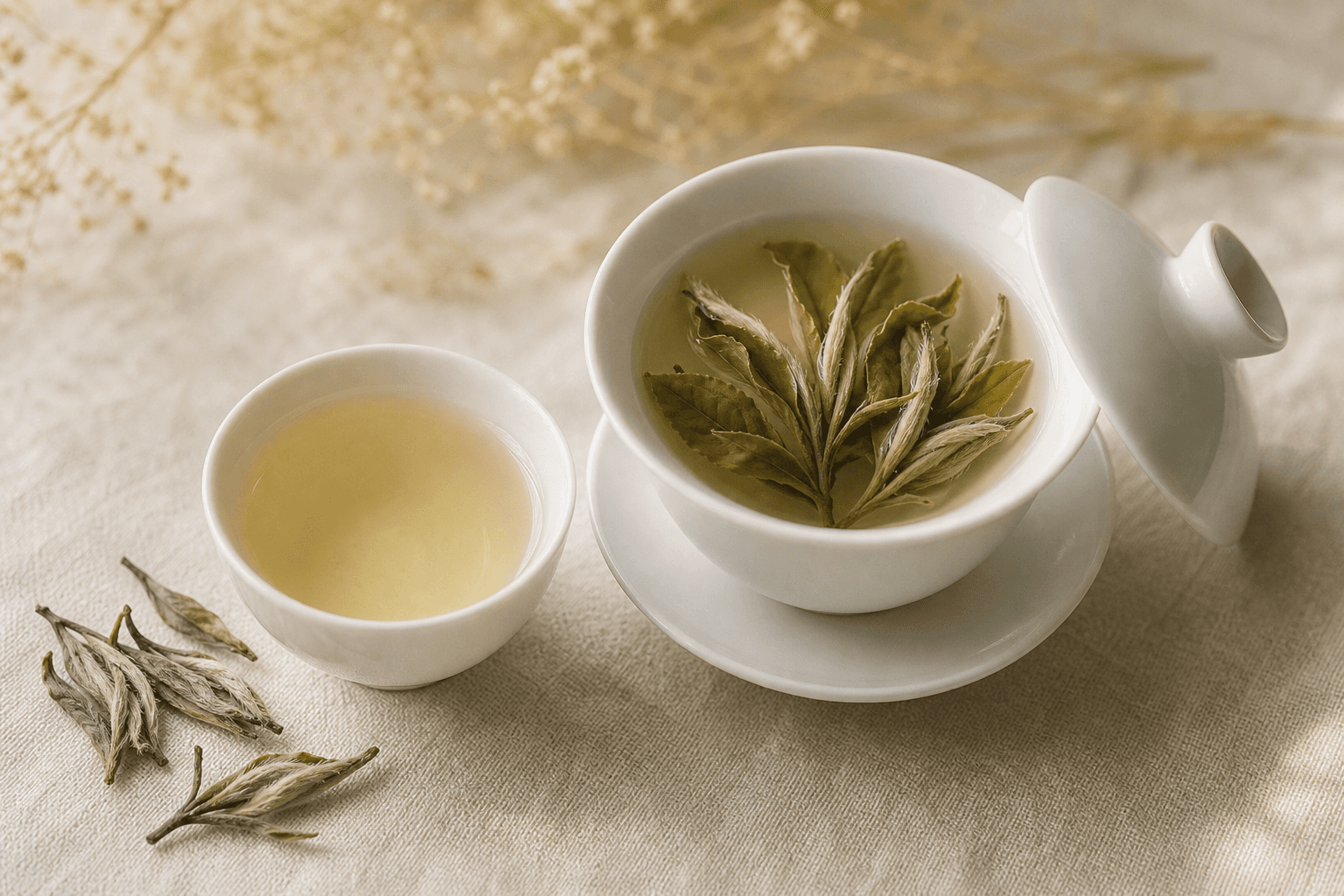
The name "peony" has nothing to do with the flower in the bush. It describes what happens in the cup. When fully steeped, the bud-and-leaf sprigs unfurl and float open with the bud at the center and the two leaves spread to either side — the silhouette of a peony petal, suspended in pale liquor. Drinkers in Fuding teahouses gave the tea its name long before any marketing did.
The same broad-leaved cultivar is also grown across the provincial border in Zhenghe, where the cooler hills push the harvest a few weeks later and yield a slightly sturdier leaf with deeper hay notes. Fuding stays the spiritual home — its sea-influenced spring, with long misty mornings and clear afternoons, is what makes the sun-wither possible at all.
Flavor
Bai Mu Dan asks for restraint. Pour 80°C water — never boiling — over four grams of leaf in a 100ml gaiwan and let it sit a full thirty seconds before the first decant. The liquor pours pale champagne with a green-gold edge, almost weightless in the cup. A boiling pour scalds the bud-fuzz off the leaf and turns the cup astringent; the gentler temperature is what lets the wildflower notes step forward.
Across five or six infusions the cup widens slowly outward. Early steeps are hay-fields and meadow water — clean, dry, faintly sweet. Mid-session a soft honey settles in, with a cucumber-skin coolness underneath. By the tail steeps the leaves have fully unfurled into their peony-petal shape and give a last whisper of warm grass before letting go.
Light-bodied, almost watery in the best sense — meadow grass and pale honey through the middle, with a cool cucumber-skin freshness sitting under the sweetness.
Gentle and lingering. A soft return of warm hay and a quiet floral breath that fades slowly without any astringency catching the back of the throat.
Across the session
Pale and clean — hay-fields and meadow water, the bud-fuzz still drifting in the cup.
Honey opens up with a cool cucumber-skin freshness underneath; the leaves fully unfurl.
The peony shape is complete in the gaiwan; warm grass and soft floral take the cup.
Sweet, water-thin, contemplative — the leaves giving up their last gentle warmth.