Cassia · Roasted · Mineral
A Wuyi rock oolong grown alongside Da Hong Pao but with its own signature: pronounced cassia-bark spice, deep charcoal roast, and the wet-stone minerality known as yan yun — "rock rhyme."
Brewing Guide
In Traditional Chinese Medicine, Rou Gui is read as warming and circulating — a cup that "moves the middle" and dispels damp cold. The cassia note is not incidental to the framing: cinnamon-cassia bark itself, gui pi, is one of the oldest warming herbs in the Chinese pharmacopeia, and a tea that carries the same aroma is read in the same register. In the cliff villages it is the cup poured in winter, after a long meal, or on the kind of damp grey morning when a green tea would feel out of place.
Modern phytochemistry traces a similar shape. Wuyi rock oolongs sit between green and black tea on the oxidation curve, retaining a meaningful share of catechins while developing the theaflavins and theabrownins of fuller fermentation. The slow charcoal roast appears to encourage polymerised polyphenols specific to roasted oolongs, and the cultivar itself is unusually rich in the volatile aromatics — cinnamic compounds, methyl cinnamate — that give Rou Gui its cassia signature. None of this is a medical claim — but it does explain why the cup feels the way it does: warm, present, quietly stimulating without the edge.
Tradition
A classic winter cup in the Wuyi cliffs — said to dispel damp cold, warm the middle burner, and quietly move stagnant qi through the body.
Modern lens
Rich in cinnamic aromatics shared with cassia bark itself; roasted oolongs are studied for their effect on peripheral circulation and metabolic warmth.
Tradition
The after-meal cup of choice in Fujian — drunk to cut through oily food, dissolve stagnation, and settle a slow stomach back into rhythm.
Modern lens
Roasted oolong polyphenols are studied for their support of pancreatic lipase activity and the microbial ecology of the lower intestine.
Tradition
Considered "clarifying" — drunk by scholars and tea masters through long sessions for a steady alertness without agitation.
Modern lens
Caffeine paired with substantial L-theanine; the long roast smooths the catechin curve and the cassia aromatics add a subtly stimulating top note.
Tradition
Long drunk as a daily tonic in the cliff villages — a leaf that "draws strength from the rock" and quietly preserves vitality across the years.
Modern lens
Sits between green and black tea on the oxidation curve, retaining catechins while developing theaflavins; the charcoal roast adds polymerised polyphenols specific to yan cha.
The Tea
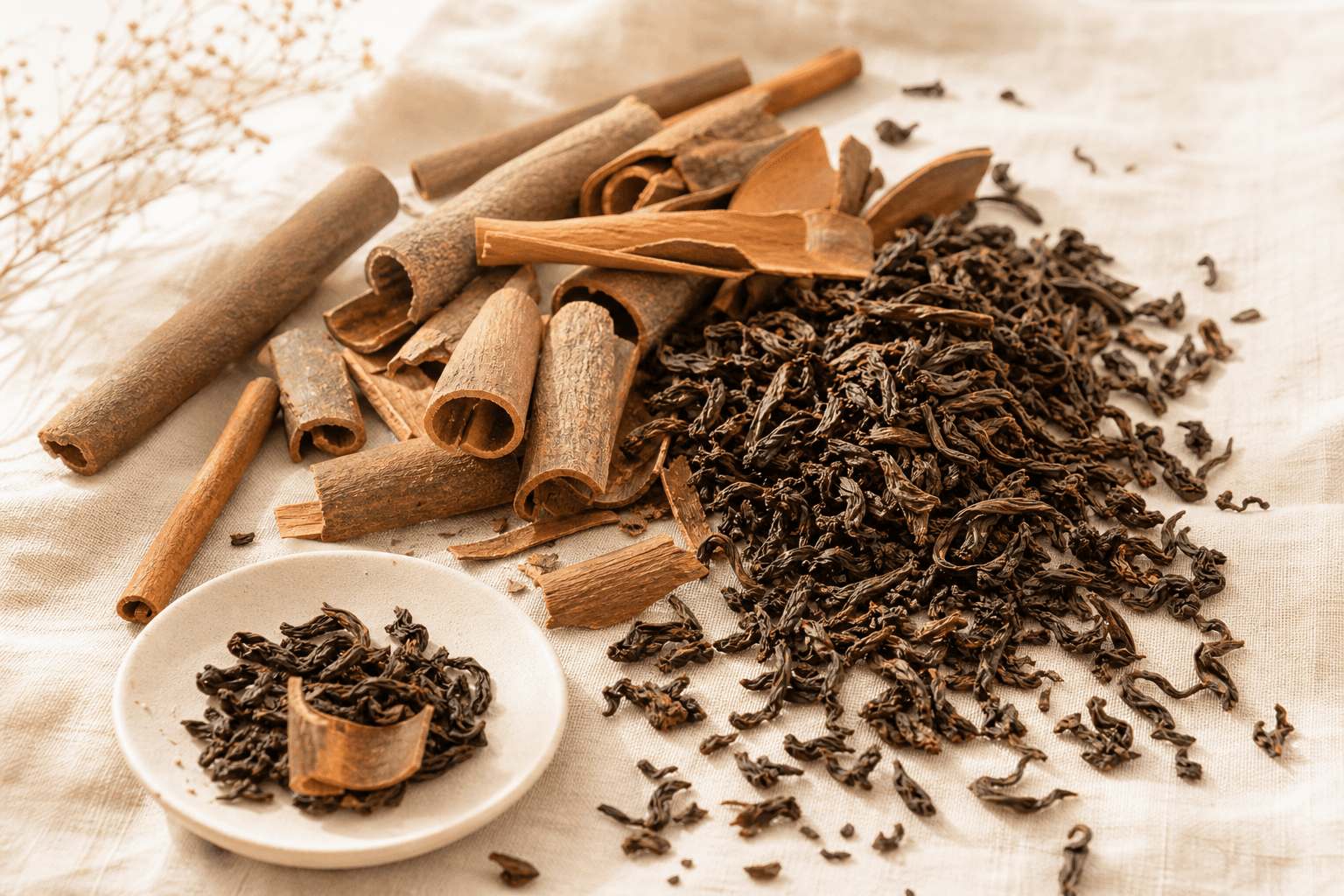
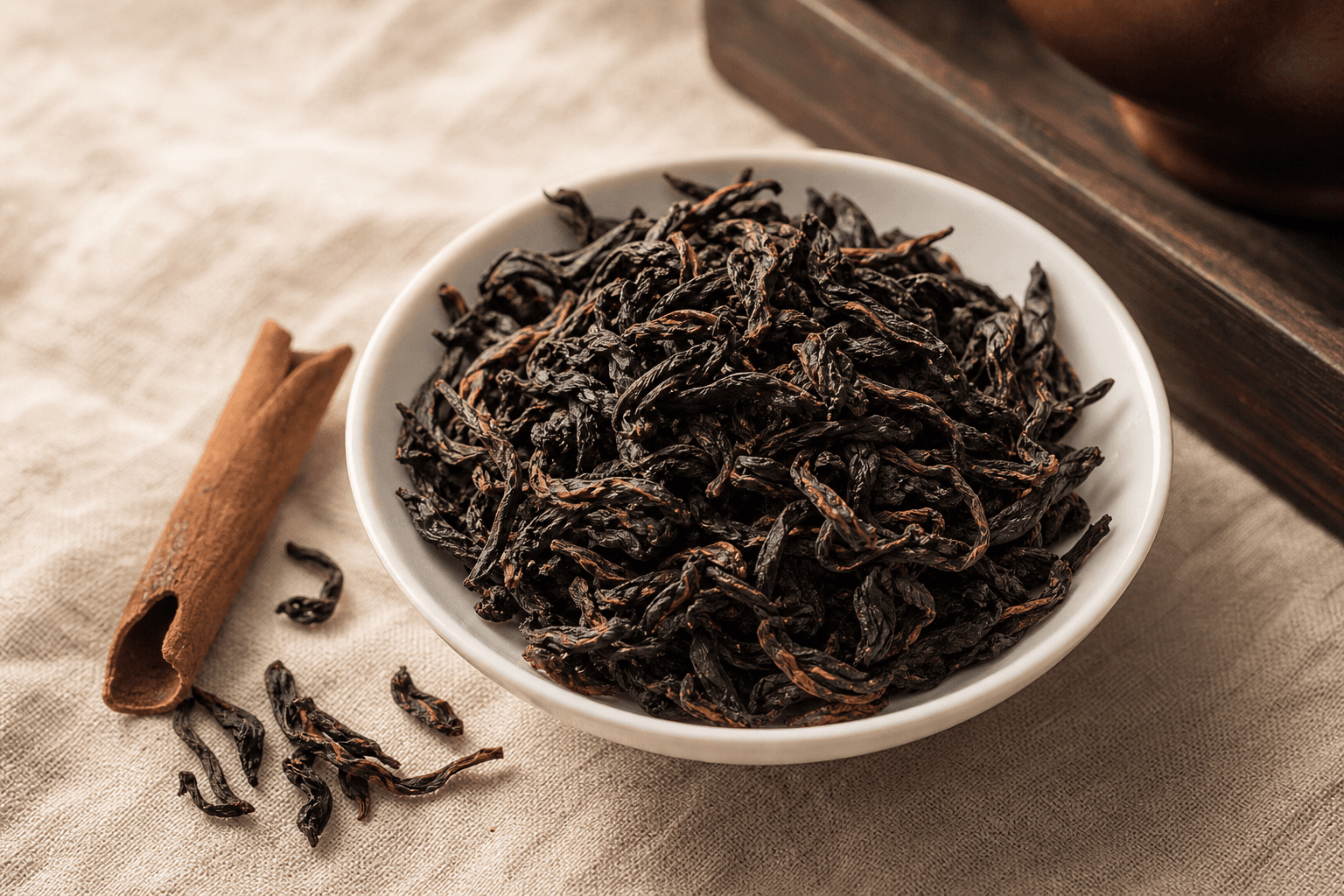
Rou Gui — literally "cinnamon bark" — is a Wuyi rock oolong cut from the same cliffs as Da Hong Pao but built around a very different signature. Where the older cultivar leans on toasted grain and orchid, Rou Gui carries an unmistakable warm-spice note the makers call gui pi xiang: cassia bark, dried cinnamon, a faint clove edge that seems to lift off the leaf before the water has even cooled. Twisted long and almost black from a slow charcoal finish, the dry leaf already smells like a spice cabinet in a warm kitchen.
The roast is the second half of the signature. A proper Rou Gui is finished in three slow passes over longan-wood charcoal — zhong huo, "medium-heavy fire" — sometimes spread across several months with long resting periods in between. The fire drives off any green edge and lets the cassia spice settle into the leaf rather than sit on top of it. Done well, the spice and the roast read as one thing; done poorly, the cup tastes scorched. The maker's patience is what you are paying for.
History & Origins
Rou Gui was, for most of its history, a minor cultivar in the Wuyi catalogue. Records place its cultivation in the cliffs at least to the late Qing dynasty, but the bushes were planted on the steeper, less-prestigious plots and the leaf was usually blended away into anonymous yan cha. The cassia note was noticed and named — gui pi xiang appears in nineteenth-century tea writing — but for over a century it sat quietly behind Da Hong Pao, Tieluohan, Shuixian, and the other famous Wuyi names.
Its rise was sudden. In the 1980s the Wuyi tea research institute began promoting Rou Gui as a single-cultivar style, picking out gardens in the zheng yan zone — the narrow ravines between the central cliffs, where the wet-stone minerality known as yan yun develops most fully — and pushing the roast harder than tradition called for. The combination caught. By the 1990s Rou Gui had vaulted into the top tier of Wuyi tea, and today it sits alongside Da Hong Pao as one of the two cultivars that define the style for most drinkers.
It has become the natural companion cup to Da Hong Pao on a serious tea table. The two share the cliffs, the longan-wood charcoal, the patient three-pass roast — and yet they read entirely differently in the cup. Drinkers compare them the way wine drinkers compare two single-vineyard reds from neighbouring slopes: same rock, same hands, very different conversation. That contrast, more than anything else, is what made Rou Gui famous.
Flavor
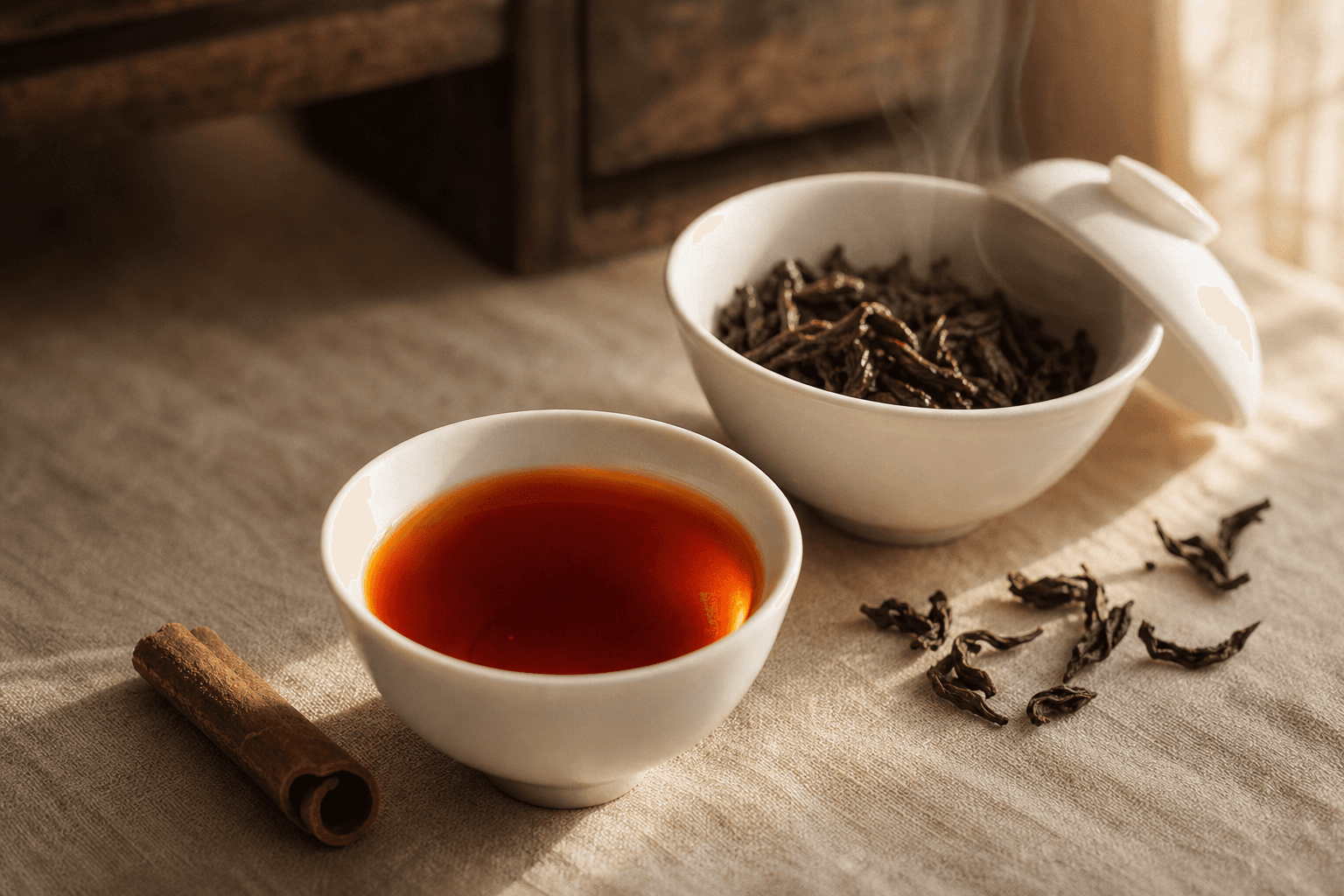
Brew at 95°C — the roast and the spice both want heat. Five grams to a 100ml gaiwan, a fast fifteen-second rinse to wake the charcoal off the leaf, then a true twenty-second first steep. Add five seconds to each subsequent infusion. The first true cup pours a clear deep amber that darkens steep over steep into burnished mahogany; the surface catches light in a glossy disc and the cassia perfume comes off the empty cup before you have set the gaiwan down.
The arc is unmistakable from the first sip. Cassia spice leads — warm, dry, almost peppery on the tip of the tongue — over a base of charcoal-roasted depth and the wet-stone minerality of zheng yan terroir. By the third or fourth infusion the spice begins to braid with a quieter sweetness underneath: dried longan, a hint of sandalwood, a soft warm-honey edge in the empty cup. Late steeps trade the spice for length: a long mineral throat-warmth and the slow build of hui gan that good yan cha is named for. Eight to ten infusions is normal; pushed gently, more.
Round and warming on the tongue, no astringency where the roast was patient. Dry cassia spice meets dark-honey sweetness over a mineral spine, with a faint clove lift mid-cup.
Long, warming, almost peppery at first then cooling into stone. Hui gan returns as a slow throat-warmth that builds through the session and lingers well past the empty cup.
Across the session
Cassia leads — bright, dry, almost peppery — over charcoal and the first hint of wet stone.
Spice and dark-honey sweetness twine together; sandalwood and dried longan rise in the empty cup.
The cinnamon recedes and the mineral spine of the cliffs steps forward — yan yun at its clearest.
Soft, warm, slightly sweet — the leaves giving up their last quiet throat-warmth.