功夫 · Brewing & Ritual
How to Brew Oolong, Gongfu Style
Small pot, lots of leaf, many short steeps. The traditional method that pulls a dozen different cups from a single handful of tea.
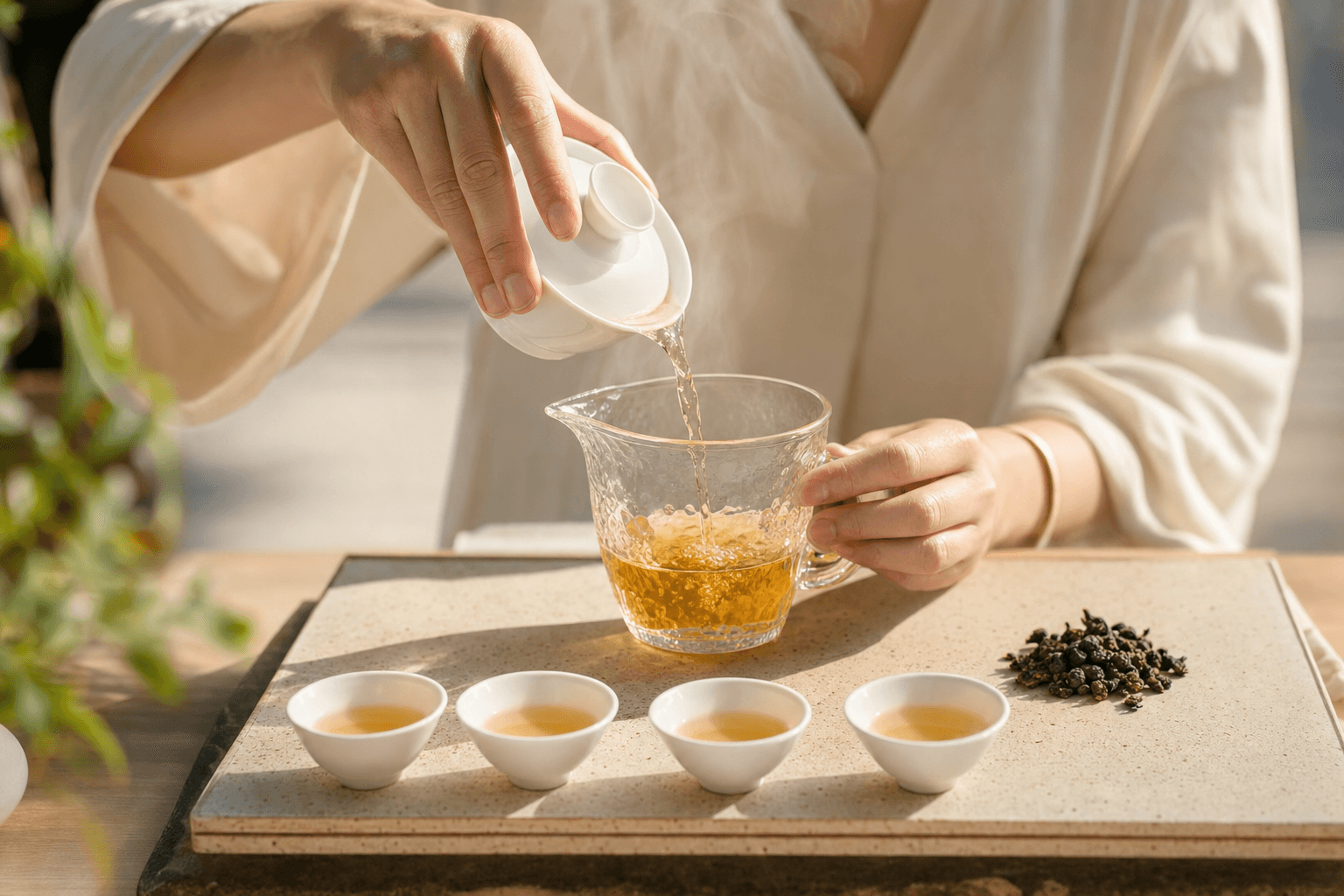
Gongfu cha (功夫茶) translates, roughly, to brewing tea with skill, or with effort. It sounds intimidating. It is not. The method is simple and forgiving: a small vessel, far more leaf than you would expect, and a run of short, back-to-back steeps.
Where a Western mug gives you one flat cup, gongfu cha pulls a dozen different ones from a single handful of tea. Oolong is the leaf it was made for. Over a session you watch one tea open, deepen, and slowly fade, telling its whole story in your cup.
功The idea
One leaf, many cups
The difference between gongfu cha and a big mug is one of philosophy, not equipment. A Western brew uses a little leaf in a lot of water for a long time, drawing everything out at once into a single, settled cup. Gongfu cha inverts that. You pack the vessel with leaf, cover it with a small amount of water, and pour it off in seconds.
Because the leaf-to-water ratio is so high, each steep pulls only a thin layer of what the leaf has to give. Pour quickly and you can return to the same leaves again and again, and each round tastes different from the last. The skill is not in following a recipe. It is in learning to read the leaf and adjust as you go.
You are not brewing a pot of tea. You are having a conversation with one handful of leaves, a short cup at a time.
器What you need
A small kit
You need less than you think, and we will be honest up front: we sell tea, not teaware, so none of this is a sales pitch. Start with what you already own.
- A gaiwan or small teapot. A gaiwan, the lidded cup, is the classic choice and the most forgiving: cheap, easy to clean, and open enough to watch the leaves. A small clay or porcelain pot of roughly 100 to 150ml works just as well. Smaller is better than bigger.
- A fairness pitcher. The gong dao bei, or pitcher of fairness, is a small jug you decant the finished tea into before serving. It stops the brew from over-steeping and makes every cup the same strength. Any heatproof jug or glass measuring cup will do.
- Small cups. Gongfu cups are tiny, a few sips each, so you taste a fresh pour often rather than nursing one large mug. Espresso cups or small glasses are a fine stand-in.
- A kettle. Anything that heats water and lets you pour with some control. A gooseneck kettle is lovely but not required.
If all you own is a gaiwan and a heatproof jug, you are ready to begin. You can even brew straight from the gaiwan into the cups and skip the pitcher entirely while you find your feet.
泡Step by step
The method
Here is a full session, start to finish. The exact numbers come next; the rhythm is what matters: steep short, pour out completely, repeat.
- 温
Warm the vessel
Pour hot water into your gaiwan or pot, swirl it, and tip it out into the cups to warm those too. A warm vessel holds an even temperature for the first steep.
- 量
Measure the leaf
Aim for roughly 5g per 100ml. For rolled oolong that looks like covering the base of the vessel about one ball deep. Lift the lid and smell the dry leaf before any water touches it.
- 洗
Rinse and awaken
Pour water over the leaf and tip it straight back out within a few seconds. This quick rinse wakes tightly rolled leaves and washes off any dust from processing. Do not drink it.
- 泡
The first steep
Fill the vessel, cover, and steep about 20 seconds. Keep it brief. With this much leaf in the pot, the water is working fast.
- 出
Pour out completely
Decant every last drop into your pitcher, then into the cups. Water left sitting on the leaves between rounds stews them bitter; an empty vessel means the next steep starts clean.
- 续
Keep going
Add roughly ten seconds to each following steep as the leaf releases its flavor more slowly. A good oolong will carry you through six to eight rounds, often more.
| Water temp | 90–95°C |
|---|---|
| Leaf ratio | 5g / 100ml |
| Rinse | Yes, a quick few-second rinse |
| First steep | 20 seconds |
| Each steep after | +10 seconds |
| Infusions | 6 to 8 |
| Vessel | Gaiwan or porcelain pot |
Starting parameters for oolong. Adjust to your taste, not to the stopwatch.
叶The arc of a session
Reading the leaves
Tightly rolled oolongs begin as hard little pellets and open over the first few steeps, often unfurling back into whole, intact leaves. That slow opening is why the early cups taste lighter: the leaf has not fully expanded yet. By the third or fourth steep it is wide open and giving its fullest flavor.
Follow the arc across a session. The opening cups run high and floral. The middle cups deepen, rounder and fuller, often with a roasted or nutty turn. The later cups thin toward something clean and mineral, the taste of the leaf itself. Watch, too, for hui gan (回甘), the returning sweetness: a cool, sweet sensation that rises in the throat a beat after you swallow. It is one of the great pleasures of good oolong, and gongfu brewing draws it out.
A great oolong does not peak and quit. It changes shape from cup to cup, and the whole art is keeping up.
乌Across the spectrum
Three oolongs, one method
The same method suits the entire oolong spectrum, from green and floral to dark and roasted. Here is how each of our three drinks across a gongfu session.
- Iron Goddess of Mercy. Anxi Tie Guan Yin (安溪铁观音), tightly rolled and lightly roasted. The pellets open dramatically over the first three steeps, climbing from a high orchid lift to a fuller cup with a gentle roasted edge underneath, then settling into a long, faintly sweet finish. Lean toward the cooler end, near 90°C, to keep the florals bright.
- Mountain Crown Reserve Oolong. A high-mountain (gao shan) oolong from central Taiwan, rolled and barely oxidized. It pours pale jade and drinks buttery and floral, with a creamy body and a clean orchid lift that builds for several steeps before fading into a quiet, sweet hui gan. The most delicate of the three; keep your water at the lower end and your hand quick.
- Ember Crown Reserve Dark Oolong. The same kind of leaf carried through a long charcoal bake. This one wants hotter water, close to boiling, to open the roast. Expect a golden-brown cup, warm roasted chestnut up front, and a sweet, toasty finish that hangs at the back of the throat. Forgiving, and it holds its flavor deep into a session.
Where to start
New to this? Begin at the two ends of the spectrum, the bright rolled floral and the deep roast, and let the contrast teach your palate what oolong can do across a session.


戒Common stumbles
Where it goes wrong
Almost every disappointing gongfu cup comes down to one of a handful of fixable habits. If a session falls flat, start here.
Common questions
Gaiwan or teapot, which should I use?
Either works. A gaiwan, the lidded cup, is the easiest place to start: inexpensive, simple to clean, and open enough to watch the leaves and smell them between steeps. A small clay or porcelain pot holds heat a touch better and feels lovely in the hand. For oolong, porcelain or a gaiwan keeps the aromatics clean and bright. Start with a gaiwan and graduate to a pot if you fall for the ritual.
How many steeps will I actually get?
A good oolong gives six to eight infusions, and a generous high-mountain or roasted oolong can stretch past ten. The leaf releases its flavor in layers, so the early cups are light, the middle cups are fullest, and the later ones thin out gently. When a steep comes out pale and flat even after a long soak, the leaves are spent.
No gaiwan, can I do this in a mug?
You can get most of the way there. Use a generous pinch of leaf, cover it with a little hot water, and pour the liquid off into a second cup after about twenty seconds rather than letting the leaves sit. Repeat, adding time each round. It is less elegant than a gaiwan, but the principle, lots of leaf and short steeps poured clean, is exactly the same.
Why so much leaf?
Because the steeps are so short. A high leaf-to-water ratio is what lets each quick pour taste full while leaving plenty behind for the next round. Use a Western amount of leaf and your flash steeps will taste like warm water; pack the vessel and every brief cup arrives complete.
What water temperature should I use, and do I really need to rinse?
Aim for 90 to 95°C for most oolong, and nearly boiling for a dark roasted oolong like Ember Crown. As for the rinse, yes, a quick one helps. A few-second rinse that you pour away wakes up tightly rolled leaves and washes off any dust from processing, so your first real steep tastes clean and opens faster. Do not drink the rinse.
Shop as you read
The teas in this guide

Keep reading
Brew it the traditional way
Single-origin Chinese tea, hand-picked and sealed fresh. Free shipping over $80, and 15% off your first order.